Tuesday, October 24, 2006

Modern Tamil Poetry and Dalit Literature in Muse India


I do not remember how I discovered Muse India - the literary ejournal, but I am happy I did so. This is an invaulable site for anyone interested in the literature of India. The Sept-Oct issue has Modern Tamil Poetry as its main focus and Dalit Literature as its feature.

There is also a section with tributes to the philosopher and writer Raja Rao who died recently.

The regular sections include Articles, Fiction, Poems, A-muse-d and Young Voices.

And then there are the archives too!

Click here to get to the Sep-Oct issue.

Friday, October 20, 2006

Legacy of Gandhi

Remember Gandhi’s last words - “Hey Ram!”? There is something disconcerting about this utterance of his. That the unassailable and unprecedented sacrifice of the god from an epic and Gandhi’s own experiments with truth had an instantaneous alienation effect on me. How unrealistic and deservedly dismissed were his ideology and its practicable relevance to a country which was fast tracked to democracy where traditions and modernity clashed perpetually? How much was Gandhi on show as an unattainable model for the rag tag pretenders who used him as a ruse for their criminal ineptitude in governance and lack of vision? Wasn’t his sainthood a malignant condemnation too?

Gandhi had captured the imagination of many generations and touched the pacifist nerves of many. However I wonder how much this man was never given his due with any decent measure of analytical studies on his contributions and relevance to such basic areas such as the real body politic of India, perceptions of Indian politics from the west and India's relationship with its neighbors and former Colonial boss. I think we kind of lost the supposedly smart pragmatic Gandhi between the heaps of malicious sleights and adulations for his gullibility/charlatan effect and sainthood respectively. Instead his last days were seen wallowing among rabid communal mobs.

George Orwell's take on Gandhi gives a bit of perception on the Gandhi-an effect. It was interesting to find his observation on Gandhi's non-violent strategies holding water against totalitarian regimes. He was wondering how a Stalin or a Hitler would have dealt with Gandhi and how long? Did Gandhi have much of a clue on the complex scenario where cultures collide and geopolitical conflicts can take massive marauding of civilizations in its stride, let alone elicit genuine appreciation of freedom aspirations of a colony? In Orwell's words - Gandhi's assumption that all human beings are more or less approachable and will respond to a generous gesture needs to be seriously questioned. Did he think that there are no lunatics in this world? That pacifism in defiant courage can have the last laugh? And, so far as one can gauge the sensibility of whole nation, is there any apparent connection between a generous deed and a friendly response? Is gratitude a factor in international politics?

How much is he relevant in today's world where innocent lives are claimed by religious terrorists and states just because of their "geopolitical" identity or happenstance? I also share Orwell's "aesthetic distaste" for his ascetic ways. Could there be a middle path between the gullibility of sainthood and the anti-human disposition of a reactionary or at worst an appeaser? Apart from deducting moral fables for the corrupt and sometime anti-national politicians, what is/are Gandhi's legacy?

* * *

If you withdraw yourself from the treachery of real politic and juxtapose Gandhi against each of these dark thoughts, you might just see that the foremost factor that endeared Gandhi to the mass was his accessibility. He spoke to the common man and presented an opportunity of alternate programs for sustenance which was essentially an antidote to the modern malady of greed and vanity.

Would he have become an anti-industrialist? Would he have become an environmentalist? Would he have become a peacenik? Nobody could have predicted and he didn’t live long enough in independent India. Fact is India never had anyone good enough to leave right templates for good governance and political edifices.

My imagination tells me that had he lived a bit longer, he would have started building the nation from bottom up. His faith in the moral and ethical conflicts in the minds of oppressors and exploiters at the farms and cottage industries could have had the most spectacular and benign effect to lead the nation to the best cost-effective model of economy and just distribution of resources and wealth.

But I can only imagine. The farmers suicides, genetically mutated human forms around chemical factories, putrid waters in the rivers, India’s ascent to the throne of corruption and state violence – could Gandhi have swayed the will of Indian politics and people to a just and benevolent future? I can only imagine.

I think that is Gandhi’s legacy. For all his frailties, he left a dream behind that after all we can still remain human and be kind to each other despite being ourselves.

Gandhi and Poetry (a poem by K. Satchidandan)
One day a lean poem
reached Gandhi’s ashram
to have a glimpse of the man.
Gandhi spinning away
his thread towards Ram
took no notice of the poem
waiting at his door,ashamed at not being a bhajan.
The poem now cleared his throat
And Gandhi glanced at him sideways
through those glasses that had seen hell.
“Have you ever spun thread?” he asked,
“Ever pulled a scavenger’s cart?
Ever stood in the smoke of
An early morning kitchen?
Have you ever starved?”
The poem said: “I was born in the woods,
in a hunter’s mouth.
A fisherman brought me up
in a cottage.
Yet I knew no work, I only sing.
First I sang in the courts:
then I was plump and handsome
but am on the streets now,half-starved.”
“That’s better,” Gandhi said
with a sly smile. “But you must give up this habit
of speaking in Sanskrit at times.
Go to the fields. Listen toThe peasants’ speech.”
The poem turned into a grain
and lay waiting in the fields
for the tiller to comeand upturn the virgin soil
moist with new rain.

Thursday, October 12, 2006

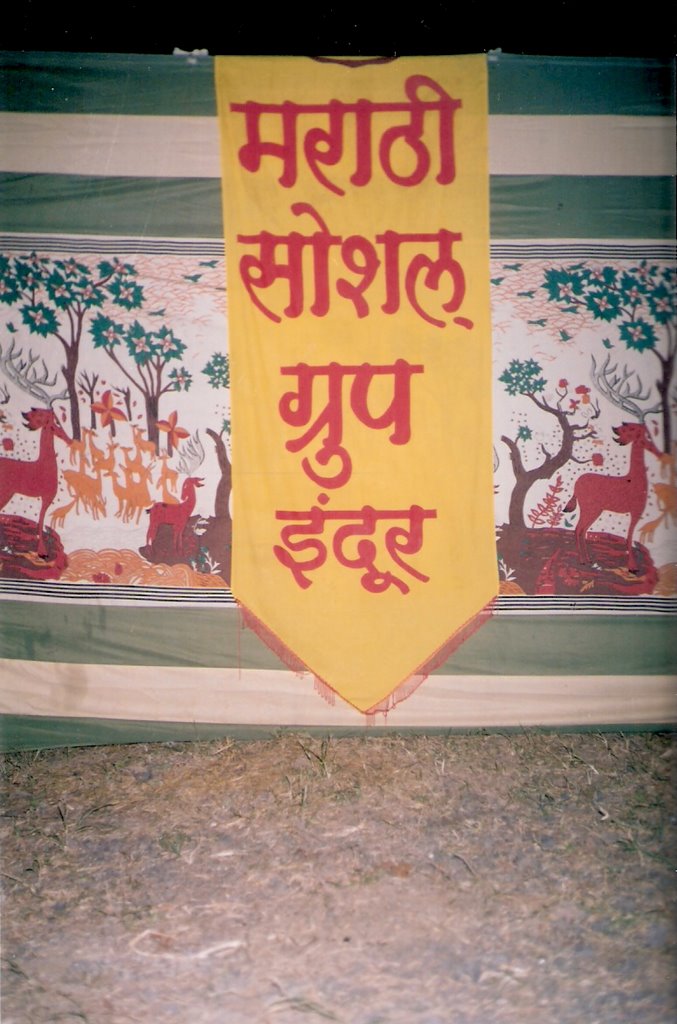
Jatra 2006 - the Marathi Festival held in Indore (MP); India


The Jatra is an annual feature in the cultural calendar of Indore - the commercial capital of Madhya Pradesh and the erstwhile capital of the Holkar Kingdom. Jatra is a Marathi festival conducted by the Marathi Social Group Indoor (as Indore is traditionally known among the Maharashtrian community). I had attended it last year and had savoured the ambience, the dances, the music, the snacks. And also been part of a pangat - a sitting in a traditional Marathi meal. (Thanks to my friend MM in Mumbai who told me what a pangat is.) But I had forgotten to take my camera - something I always regretted.

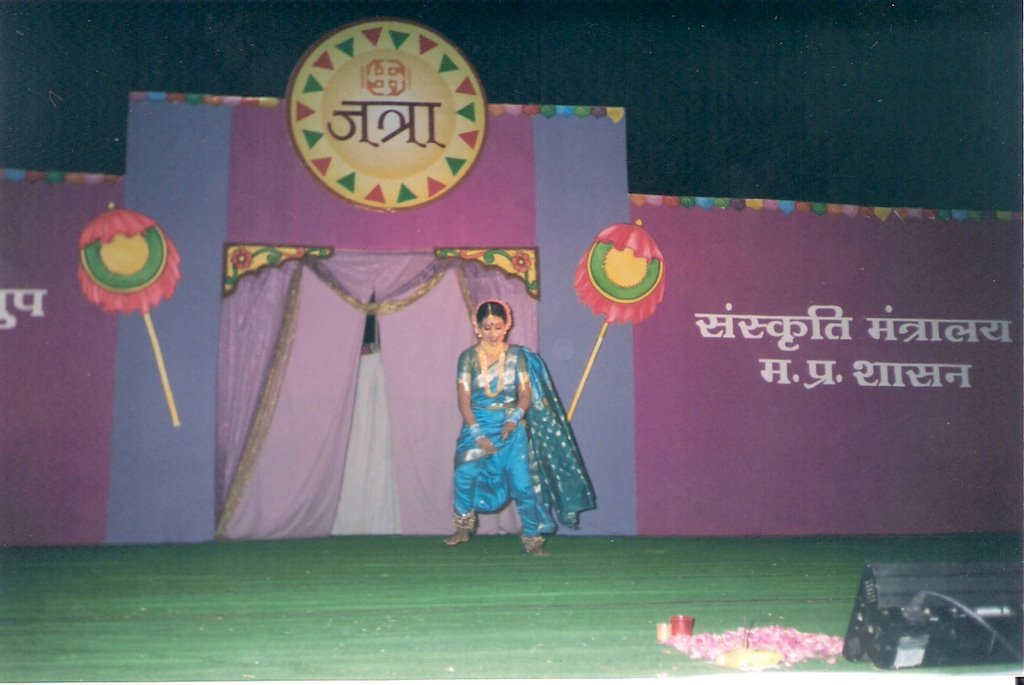
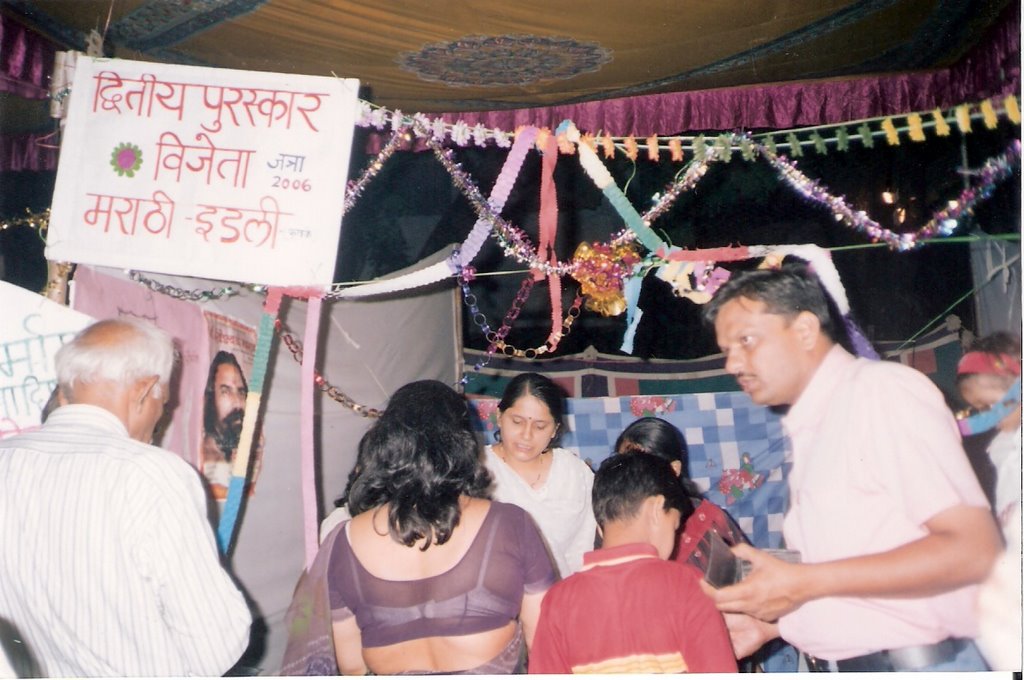
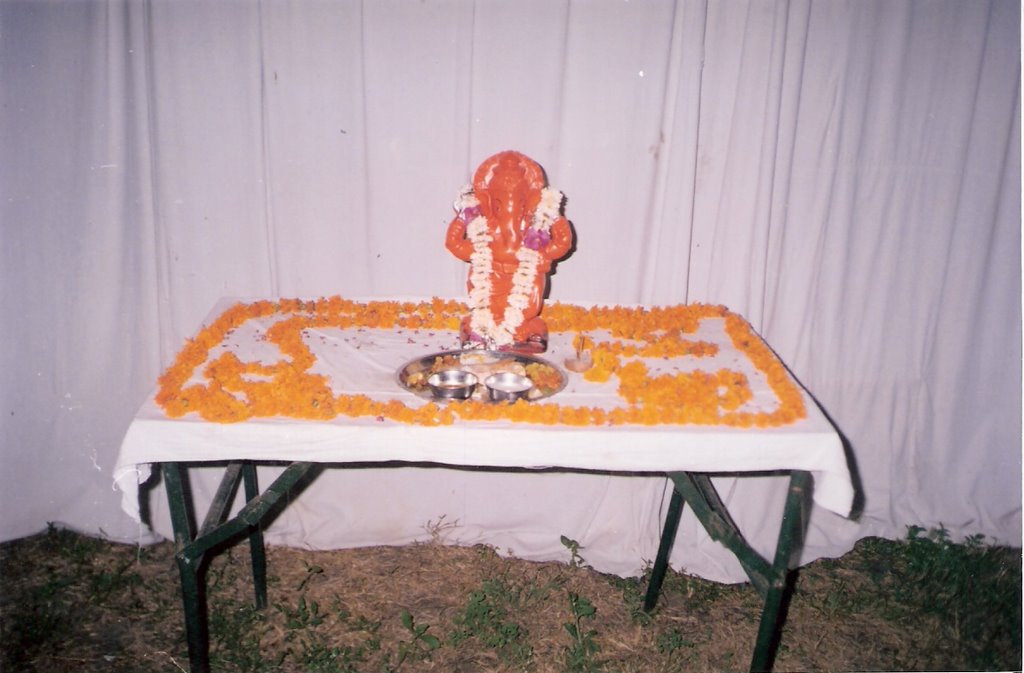
This year Jatra 2006 was held at the Poddar Plaza, near Gandhi Hall, Indore from the 6th to the 8th of October. I visited it on the 8th. Driving down from Mhow, where I live, took me about an hour. Iqbal, who happens to be one of the regulars cab drivers I hire, told me that he would be breaking his Ramzan fast at 6:15 pm or so and that he would definitely pick me up by 7 pm. He was true to his word and we were out of Mhow by 7 pm. I took my camera, a simple Yashica MF2, along and captured some images from the last day. Here they are. A beautiful evening. Something I have begun to look forward to every year.


The Lavani dances. These performances were watched by a packed audience.


Two of the many stalls in the food zone. One can see the matki vada and marathi idli stalls.


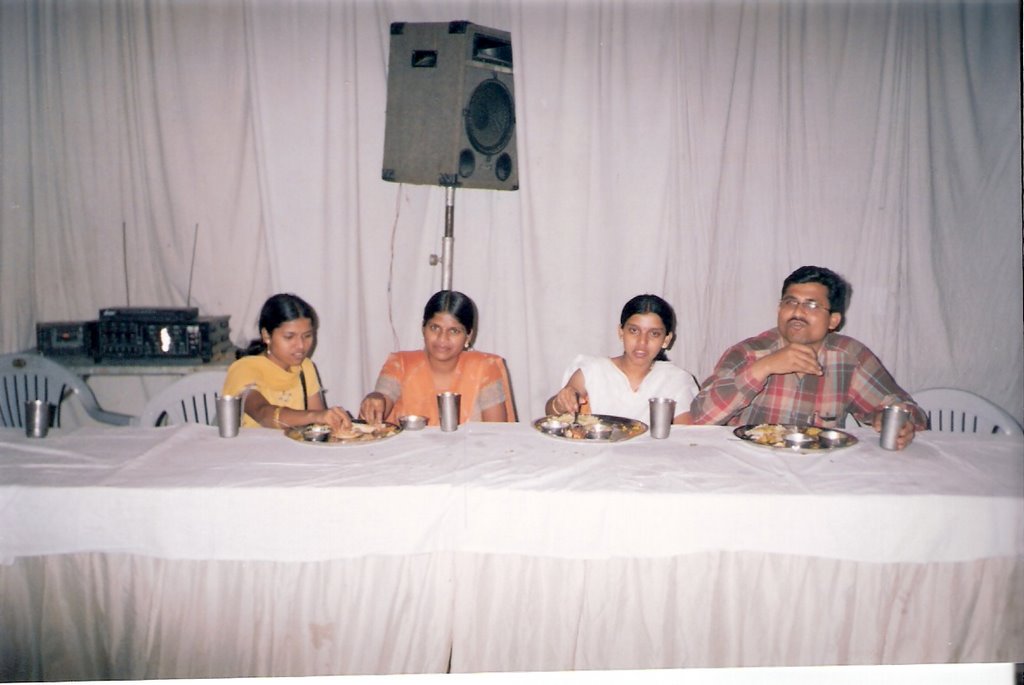
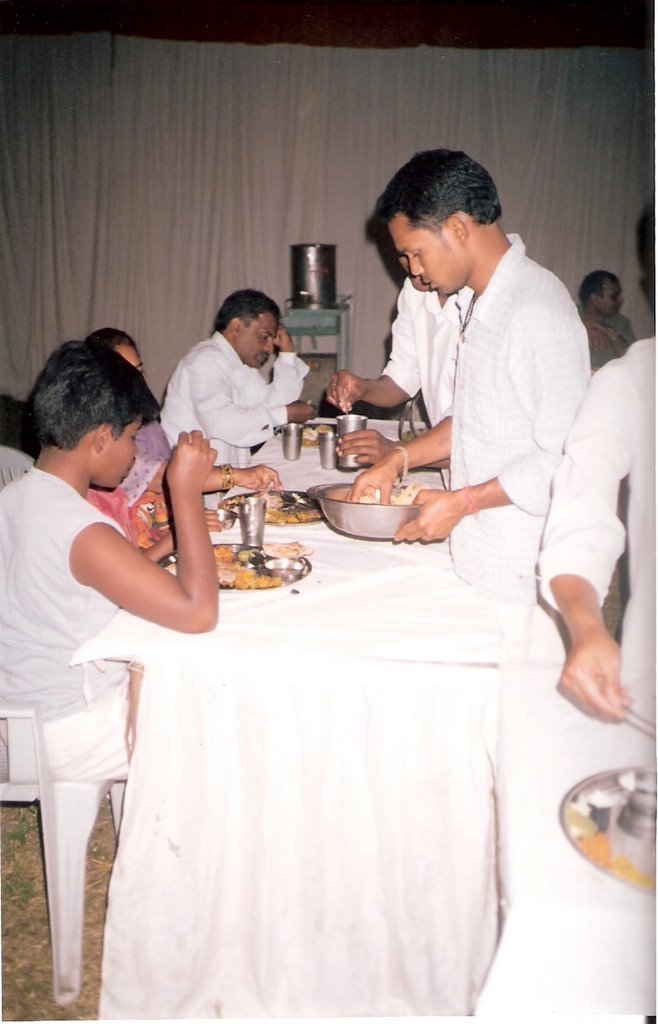
Participating in a pangat and eating a traditional Marathi meal. The menu for the meal is written on the blackboard. I have it written down somewhere. Must find it.


Enjoying their meal. They were very gracious in allowing me to click them. But I had to wait till the giggles had subsided.


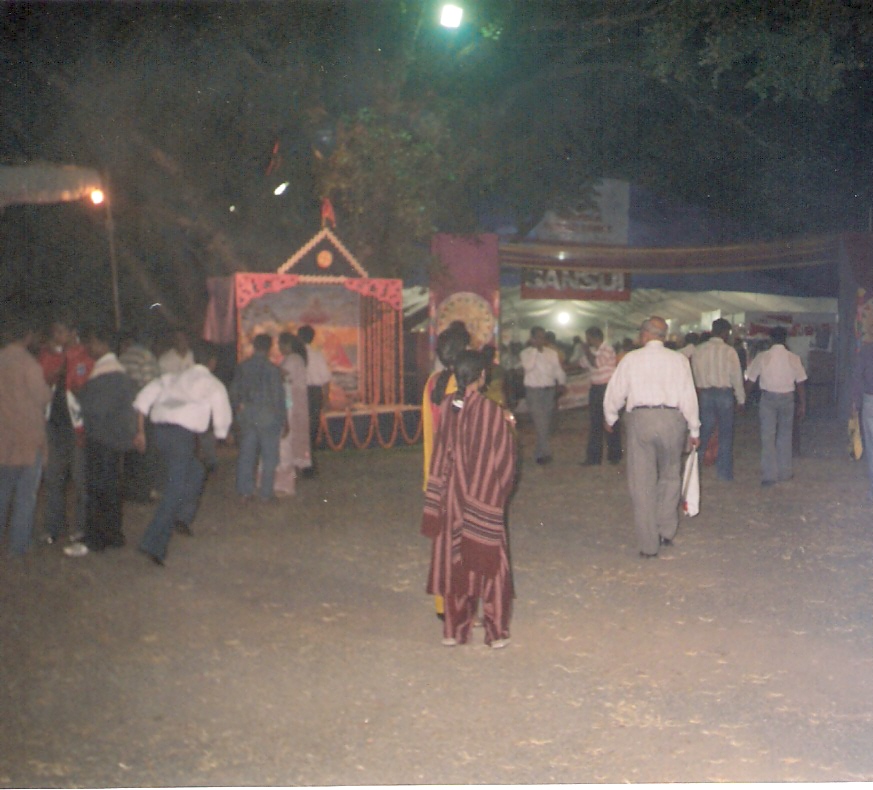
Time to say goodbye. People walking in as I walk towards the parking lot. I wanted to stay longer but it is at least a 25 km drive till my house. Till the next year and the next Jatra.

Monday, September 25, 2006

Remembering Padmini the graceful actor and dancer


My mother told me yesterday morning that the actor and dancer Padmini is no more. I felt that one chapter of my childhood had ended. As a young child growing up in various cantonments the weekly Hindi movie was a great educator and to some extent it neutralised the negative effects of being deprived of Indian inputs. My mother would often talk of Padmini and her sisters. The 'Travancore sisters' as she called them. I guess for someone from outside Kerala and especially for someone from outside South India Padmini would have been just one of those heroines who made the hero's world a little more colourful. In a state like Kerala she must have shocked many by entering the celluloid world. Inspite of their matrilineal traditions and the immense freedom their women enjoyed the land owning Nairs must have been shocked. Not unlike the case of Mallika Sherawat and the conservative society of Haryana. In Mallika's case the desire to shock was a calculated one in Padmini's case the fact that she was acting in films was enough to shock the orthodox.

My mother is my source of information as far as commercial Malayalam cinema is concerned. When she told me some years ago that Shobana ('Dance like a Man', 'Anantaram') is Padmini's niece I became extremely attentive. Another cousin Sukumari is also a one-woman institution in Malayalam cinema. Padmini's ouevre in Hindi cinema was limited but will be remembered. "Payal" [1957], Babubhai Mistry's "Mahabharat" [1965], Raj Kapoor's "Jis Desh Mein Ganga Behti Hai" [1961], and "Mera Naam Joker" [1971].

Her film debut in Udai Shankar's Kalpana, the manner in which she left Travancore and established herself in the Madras film industry, acted in films made in all the South Indian languages and made her mark in Bollywood long before anyone had heard of Kamalahasan or Sridevi is something which has never been recognized. Maybe if she had been a man.

Some excellent links to Padmini are available here.

Tuesday, September 19, 2006

Futility

The little candle eagerly waited
For the match to
Light the flame
And make its life real.
And it waitedAnd waited……


As
All the matches
Were staring at the lamp
And the wonders of electricity
Hoping they could be a
Part of thisNovelty.
Wondrous and beautiful
Full of light….
And the candle and the matches
Waitedand waited
till eternity....

Friday, September 15, 2006

Sarai Reader 06: The theme is "Turbulence"

Amardeep Singh, Assistant Professor of English at Lehigh University has created one of the best literary blogs. I check it out at least once a day. Thanks to this entry in his blog I came to know about issue #6 of Sarai Reader. The articles are available in pdf format.

I have just seen A Candle in my Window by Peter Griffin, whose articles I often read in The Times of India. Peter writes about collaborative blogs and how he and his online friends started an online initiative named Tsunamihelp which evolved into the South-East Asia Earthquake and Tsunami Blog (SEA-EAT blog). A fascinating read. It shows how some of us have harnessed the awesome power of the internet to make a positive difference to the lives of the less fortunate.

Amardeep recommends A City Feeding on itself: Testimonies and Histories of 'Direct Action' Day by Debjani Sengupta. A horrifying account of the riots that took place in Calcutta in 1946.

In Poetry In a Time of Terror the Shillong based Manipuri poet Robin S Ngangom writes of the pain and trauma that the people of his state are going through.


And there are the previous issues too
Reader 1 has 'The Public Domain' as its theme.
Reader 2 has 'The Cities of Everyday Life' as its theme.
Reader 3 has 'Shaping Technologies' as its theme.
Reader 4 has 'Crisis/Media' as its theme.
Reader 5 has 'Bare Acts' as its theme.

Plenty of good stuff here folks. Click away. Thanks Amardeep.

p.s. This happens to be my first post in Neti Neti. Here's looking forward to a long and fruitful association.

Saturday, September 09, 2006

Onam

Onam is about homecoming. A spirit that takes our being from all corners of the world and swoop in around a magical table where everyone gathers to munch on foregone tastes and memories - of childhood, parents, siblings, flowers and sunlight in the neighborhood.

Let Mahabali return to see us who are after all the same old ourselves - simple and warm people.

Ellavarkkum ente Onaasamsakal.

September: A sudden light shower in the morning, left the yard exhilerated and let it regain composure. The laughter and mirth from the living room grew with sunshine. Today is Onam. There is a weightlessness in reunion and barricading time to slip any further. Spring is now and hope is in the moment. (from an older Article)

* A little late to post this. Better late than never :)

Thursday, August 31, 2006

Ayyappa Panicker passed away

Dr. Ayyappa Panicker(1930-2006) was one of those rare breed of people you would call vocational intellectuals, the ones that you are aware of their appearances in magazines, award committees and the stellar academic achievements but never identified with their work or persona like say some one like O.V.Viajayan or a Borker or Khandekar.

Though regarded a prominent poet attributed with architecting modern Malayalam poetry, he is a ubiquitous man of letters who was active in a lot of movements from behind. He completed B.A Honors from University college, Trivandrum, received Ph.D from Indiana University, for his dissertation on Robert Lowell's poetry. In 1980, he was appointed Professor in the Institute of English and Head of the Department and continued to hold the post till his retirement. The University Grants Commission made him National Lecturer in 1984-85 and he gave lectures in the universities of Gorakhpur, Kolhapur, Karnataka and Bangalore. He was a visiting Professor at Jadavpur University, Calcutta.

"In 1981-82 he did Postdoctoral Research in Yale University (five months) and Harvard University (four months). During this time he visited around 25 Universities in the U.S and became acquainted with internationally renowned poets like James Dickey, John Hollander, Czeslaw Milosz and Allen Ginsberg as well as scholars like Cleanth Brooks, Harold Bloom, Charles Feidelson,Jr., Frederic Jameson and others. "

I quoted this from his website and apparently he was an insider and was regarded as the point man for Indian culture and specifically malayalam literature and art with international reputation. Inevitably he traveled all over the world and attended countless seminars and represnted Indian Literature and Culture. He was also a major endorser of writers and specialised in writing "forwards" for many established writers and sometimes beginners too. No wonder he used to remind us a lot of Harold Bloom.

His contributions in criticism are regarded higly in the fields of comparative literature, especially for poetry in malayalam with English and other Indian languages such as Tamil, Marathi, Kannada, Hindi, Telugu and Bengali. He was also a lifelong celebrity as an English and Linguistics teacher. He effortlessly went along with the essentially leftist intelligentsia in Delhi and Kerala. In short he lived a worthy life that deserved a lot of official obituaries and a little bit of personal ones too from an obscure outsider like me :) May his soul rest in peace and glory.

His website
Some of his poems

Wednesday, August 09, 2006

Custodial deaths and Third world citizens

Sushil Kumar, a telephone operator was arrested by Police in Delhi and two days later he was declared dead. The post-mortem report said that the shock of the beating had triggered a heart attack leading to his death. Police said he had died of “natural causes''. The same month Sukhvinder, who had been accused of sheltering alleged ISI agents, died in police custody.
(Hindu)

Mr. Udayakumar, a 28-year-old man, arrested was arrested from a park in Kerala along with his companion on grounds of suspicious circumstances, died due to severe internal injuries when he was severely beaten by policemen.
(Mathrubhumi)

Nagender, was a driver. He was an accused in a fatal motor accident case. A non-bail able warrant was issued when he did not turn up in court. When he was produced before the criminal court, he escaped from the police custody. He was immediately apprehended and remanded to judicial custody, where he died under suspicious circumstance.
(TOI)

Kamal Sharma was a guard of a cement godown in Jangal Basti at Fansideoa, Darjeeling District, West Bengal. On 6 February 2004, the owner of the cement godown, Mr. Dilip Das, lodged a complaint to Fansideoa Police Station that Rs. 92,000 was stolen from his residence. The police arrested Kamal Sharma as a suspect without any reliable evidence on 6 February 2004 and took him to the police station. No stolen money was found in Kamal Sharma's possession. He was later found dead in custody.
(TOI)


We tend to display a lot of apathy for overzealous human rights activists. But take a look at the news mentioned above and there are countless such deathly rituals in progress in police stations around the country. Dates and names don’t matter. Google for “custodial death” and you will find the distinguished position of India in this genre.

The spectacle of dehumanization at work in police stations around the country is no longer news nor does it elicit shock or anger from us. The layman in you is probably relieved that it was somebody else. You could be walking in a park or waiting for the commuter train or an unlikely suspect in a robbery case. As long as you are on your own without political clout or money, you run the risk of being snapped up from your life and the world could suddenly turn upside down for you. Or you could even be a student who mocked the home minister of a state in political overtones ended up in torture cells and vanished without a trace. Remember the notorious Rajan case during “Emergency” in Kerala?

Governments have changed, political faces have changed and the media are on an overdrive to cover anything sensational. Tragically the slaughter-culture in police thana has never been curtailed and is on an alarming rise. The victims of custodial deaths are powerless citizens of the country. Mere impression of your status as the “insignificant voter”, in the mind of a cop throws you in mortal fear. There must any number of pathologically violent cops in India who need to be identified and weeded out.

The euphemistic “rates” for police and abuse of political influence have created a widening gap between “law abiding” citizens and the poor underprivileged. Torture is the natural means of investigation when it comes to the latter category. The delays in courts, negligence of higher ranking officials to inspect illegal and prolonged custody of suspects, general lack of awareness of law among the common people are exploited to the core.

The stigma of poverty follows everywhere. The simple exercise of power by a policeman over common citizens can lead up to third degree torture and death with no access to redress grievances. Sometimes they are just expedient pawns of a larger conspiracy to hide the real but influential culprits. A little bribe is all it takes to deprive a poor man of his life.

There are several reasons that I can think of:

  • Lack of relevant training and willingness to enforce code of conduct from authorities.
  • Economic status of the country and individual. The statistics of custodial deaths are staggering for third world countries like India, Indonesia, Pakistan and Bangladesh.
  • A subculture of the community where it is OK to use violence as a means for perceived justice.
  • Ignorance of legal procedures among common people and to some extent among lower order policemen.
  • Intervention of political interests and politicization of police force.
  • Ill-planned work schedule and lack of resources for lower order police force where they are forced to be on job for way more than 8 hours everyday.
  • Terrorism laws being misused to act on poor minority (read Muslim) suspects with impunity.
  • Lack of communication and relationship between police force and neighborhood watch (if any) groups.
  • Traditional police force unable to cope with changing lifestyle and rapid development of suburban and urban areas.


The biggest motivation behind all these killings is a belief that the custodial deaths could never punish the perpetrator. Until this notion changes, there will be custodial deaths. The irony is that if you take away the uniform, the perpetrators would look exactly the same as the victim – faceless, apologetic and limp.

Saturday, July 29, 2006

Outrage?


Two pictures on the cnn website caught my eye. One had a news article on it. The other was an ad. See for yourself.


Familiar? Now this picture or its derivative has been on cnn’s website for a while. No outrage was visible. If anyone wrote in to protest that kids might be looking at cnn’s website and this was not an appropriate picture on the first page, then I definitely missed it. For my part, I have” netnanny” safely installed on my kids’ computer which blocks these pictures so I don’t worry that much.

However, when I saw this news article
http://www.cnn.com/2006/US/07/27/nursing.cover.ap/index.html


and the accompanying picture having caused outrage, I found my mind in the biggest muddle ever. When the spinning stopped, having given rise to sheer amusement at the colossal mix-up, the implication of this hit me between the eyes. Allow me to share some of this here.
The breastfeeding mother is a matter of shame(?) . While I don’t really consider myself a lactivist, and definitely do not remember ever breastfeeding in public, (I put it down to my conservative upbringing in a traditional culture), something made me laugh loudly at the stupidity of all of this. However on reading this article, especially the following lines, I realized something here smacked of a hypocrisy, more on the part of women, than the men who are blamed for being “visual.”

This line specially caught my eye.

"I'm totally supportive of it -- I just don't like the flashing," she said. "I don't want my son or husband to accidentally see a breast they didn't want to see."

While am all for this point of view, I just don’t see the same reaction at picture of half naked women on big billboards selling underwear. Something is incongruent about the acceptance of the woman’s body as sexual object, but not as a mother. Is it just me who views this inconsistency as something to ponder? What is also very interesting is that it’s the women who “doth protest too much” about the lactating breast, while remaining silent about the other ads, far more ubiquitous than the “Babytalk” magazine. Not to be dismissive, but I doubt the readership of Babytalk exceeds the viewer ship of the “Victoria Secret” ads.
As a follower of the “cult of motherhood,” is it time to take strong objection to this? Mostly tongue in cheek, of course? How is it women don’t figure out they put a foot in their mouth the moment they protest things like this, while the silent men are merely amused at the lack of feminine self identities? All while “enjoying the show” as well as the comedy of collective stupidity.

Wednesday, July 19, 2006

Contemporary Reflections...

I’m not easily given to write about politics. Let me , however, illustrate two examples from contemporary world and share my thoughts on them.

[1]It’s a mystery to me to see that a race whose average IQ is about 120 permit itself the same mistake again and again. How amazingly incongruent it is to find the people who are known to be exceedingly thoughtful in most spheres suddenly fail to see how they are becoming the victims of their own defensiveness. To put it plainly, this nation did not exist a few decades back and since its inception has been engaging or made to engage in repeated political conflicts one after another. And given the history of persecution, if at all anyone , it is them you expect to realise the futility of the course of their action- this is the third time Israel is officially entering Lebanon and the conflict is nowhere near a feasible solution, in fact one easily can see the trammelled repercussions in the near future. With the vulnerable geopolitics of the region, it is only prudent for Israel to understand the fact it cannot ensure the security of her subjects by bringing herself under the umbrella and to continuously engage in reactionary acts of questionable morality.

Israel has to, in the larger interest of the Jewish race, regard herself as a nation willing to progressively exclude herself from the troubles of her neighbourhood and thereby work towards a lasting solution which can be achieved only by concerted peaceful talks. Simply because, as we all know, parting the sea does not happen quite often.


[2]The second , perhaps the more entertaining example is the response of Indian Blogosphere to the apparent ban on a dozen websites allegedly perceived as a threat to national security. I say apparent because I lack reliable information regarding the exact nature and the premise of the ban. Except for one news-piece, all my sources are friends and other bloggers.

To me, the greatest surprise is bloggers arguing against the ban calling it unlawful and against the principles of democracy. I found a few others writing sarcastic notes stating how their art, movie or culinary posts may lead to compromise of security. And that tickles me no end making me wonder if such populations who have never been outside democracy actually deserve to be in a democracy. It has been my observation for over a period of time that , just because they have a a English medium education and a modem , Indian blogs rant their self righteous opinion right left and centre with a conviction as fixed as a lamp-post to the ground. I reckon very few people in India actually understand the concept of democracy, for the rest it is phrases like free speech, free rights etc..and more dishearteningly, all this in a nation which practised the best ever seen form of democracy in the human history to gain her independence. Esp. the 1920s-An active civil disobedience aimed at highlighting the injustice and not to embarrass the opponent.
Its all sad.
Surely, democracy entitles one to free rights and speech et al, but that does not necessarily mean you can say or act whatever that crosses your mind; that only leads to anarchy. There is nothing illegal about a democratically elected government choosing to ban a number of portals in the interest of her subjects. Neither anyone has been singled out unjustly for writing about art/movies nor anyone’s freedom of speech has been curtailed. No one has been discriminated against, it is a blanket ban and some people are affected , for no fault of theirs. It is rather unfortunate if you are to lose out in the process, but we all have to play our part in the national issues.

But yes, you are completely justified in challenging the reasons behind the ban or questioning the need for ban at all. And writing a blog claiming it as undemocratic is not the way to go about it. That amounts to nothing but airing and sharing your frustration, which in fact could be argued as misdirected practice of democracy.
PS- I personally have no view on the ban as of now, but as a matter of principle, I am for a completely justified ban by the state accountable to her subjects. When I mean justified- I mean one, based on reason and not on prejudices.

Monday, July 17, 2006

Anatomy of riots and mob violence in India

Mob violence has been occurring since human beings started recording history, verbal and written. The secular governments create environs for lumpenisation of urban and semi-urban locations with its mapping and reorientation of voter (read ideological and religious blocks). The anti-democratic or even anti-government forces would always look to use to these lumpen elements to unleash atrocities against innocent and defenseless people.

I remember watching a movie called “Z” by Kosta Gavra which narrated the ringside view of a political assassination orchestrated in the guise of mob violence. It showed the ways in which State uses the lumpen elements of society and unlawful manipulation of its machinery to eliminate political threats for survival. Cuban director Thomas Elia depicted the mob violence as an inevitable threshold of social transition and he showed no mercy for the degenerating feudal family and their extermination by the rampaging mob. Similar point of view was portrayed by Emile Zola in his book Germinal where a bunch of hapless colliers reduced to lumpen existence took to arms to survive. Amrita Pritam painted the deep wounds of partition and a nation’s conscience in her fiction Pinjar (Skeleton). Shashi Tharoor’s Riot is another recent work displaying the chimerical façade of reality and apprehensions of secular Muslim, past grievances of militant Hindu and bureaucrats functioning anarchy.

The effort to confine the flare-ups, spread and retaliatory responses of a riot in ideological (religious, secular) terms is very limiting to comprehend the experiential dimensions of the conflict. The official narratives of several parties narrow it down further to guilt of perpetrators, inciters and a presumably complicit State. While it is fairly easy to determine State and its apparatuses role what is lost in discussion is the victim’s narrative of the events as they unfold and how they become targets identified with the causes (religious or ethnic) of conflict. 1Fadjar Thufail mentions about the need of locating violence in the habitus of religious and ethnic certainty becoming the most serious obstacle to any effort to explore the narrated ephemerality of violence experience in his thesis on South Asian riots.

2Elias Canetti’s Crowd and Power (1966) in the words of Susan Sontag dissolved politics into pathology, society is treated as a mental activity and its barbaric self decoded. Crowd Vs individual, the animalistic drive to out-survive others, grips of fear psychosis and the behavior pattern of crowd being different from the individuals who make up the crowd as units. Canetti took 30 years to complete this brilliant work of rare insights and revelation.

Riots erupted after Cartoon controversies all over Islamic domiciles exemplified the sway of crowd power over seemingly insulated and free societies in Europe.

One of the memorable images from Gujarat riot was Qutubuddin Ansari’s teary eyed plea for life in front of a baying mob. The politics of this heart wrenching image is as enigmatic as the actual event. The narrative of this very image by a religious individual or a secular ideologue or an apolitical entity, would lead to further expressions of conflict in the mass media, intelligentsia and socio-political forums to understand not just the victim-perpetrator relationship, religious and ethnic undertones, flagrant spread of violence across extensive locations and linger over longer periods.

It is important to understand the local dynamics of afflicted community and trace back to the origins of conflict before the aftermath overwhelms our perception and political entities swoop in for the takeover. A self sustainable society must be able to introspect critically and allow humanistic perspectives to unravel the wounds to decide how to heal them.

I will try and follow this up with the politics of Riots.

1. Fadjar Thufail: Ph. D Scholar, Uni. Of Wisconsin. I owe him the concept of this blog.
2. Elias Canetti, German Writer and Thinker

Friday, July 07, 2006

Autumn Years and neti neti.

The reality of old age first hit me when my grandmother fell ill. Everyone knew it was only a matter of time the end would arrive. This knowledge showed in people’s lack of hope, slow actions and expression of tiredness in how they took care of her. My father kept doing things, as though she would recover, and something in that effort made me see him as a child, clinging on to the hope his mother would continue living. She was not able to move, literally a bag of bones I didn’t recognize, was not able to eat, and had to be turned every couple of hours, so she would not get bed sores. However, her eyes were clear when she was awake, and even though she did not have much strength to speak, her eyes were expressive, and the countless emotions in them did not find names in my limited vocabulary.

I remembered the time she was strong and articulate, and full of energy. Her laughter, pithy comments, and temper, were legendary. Her sense of power affected everyone who came into contact with her. She had a regal bearing about her and was able to bring this sense of authority into any situation she found herself in. As a child, I always felt she was an important person from the way people deferred to her when she was present. Also the way, they hesitated in expressing dissent when they didn’t agree with her showed something I didnt quite grasp then. Now I view these things in many different ways but as a child, there was an attraction I felt to her. Her view of the world fascinated me, which was very complex and colorful, and quite different from the black and white, good and bad world, that books and school painted for us. She sang songs and told me many stories that I don’t remember clearly. Sometimes a certain taste wafts into my mouth when I hear a tune, or a scene which matches a certain setting she had described.

Seeing her so severely incapacitated, leading upto the moments of her death, opened up doors of perception I did not know I had. For the most part I felt pity. Her regret for the things she had left undone was very visible to me. She seemed impatient to set things right and was sad she did not have the strength to do so. Her desire to express love and care seemed very innocent to me as she had lived sternly, hiding emotions and her own vulnerabilities, always insistent on being the strong person. She held onto our little hands and looked at us with deep love. Her eyes followed my father around, as he tirelessly worked to take care of her. It surprised me as she had always seemed annoyed by him when she was “alive.” His quietness, and gentle being irritated her and I was now able to see the irritation stemmed from her frustration at what she thought was his “weakness.”

It struck me then, and again at countless times, when interacting with old people, that the traps of thoughts finally overtake one’s being, as escape through action. Its almost as though the web of false beliefs that people collect over time has no escape and the more people try and act, an ability diminshed with age, the more entangled they get. Just being quiet would cause many such entanglements to fall away, crafting smiles that reach the eyes.

A well lived life creates a sense of freedom in old age that I have since seen in the eyes of many other older people, who have not left kind words unsaid, or love unshared. Is it possible that the only people, who are rich in this strange twilight of time, are those who have recognized and shared their most valuable possession, their own self? When that is given away through love, what further fear of loss can exist? The fear that all unhappy old people share has fascinated me greatly. It’s almost as though the fear is childlike, of losing their favorite toys, which over the years take shape of things, people, and beliefs. It’s also ironical to me that the more people cling to these crutches of relationships, things, the more they seem fearful of losing it. The ones who prided themselves about their physical well being react more to being ill and desperately seek cure after cure, in the hope something will restore them to a wellbeing they knew. The urgency of chasing mirges grows more desperate as time passes, creating quiet deperations and prisons in their minds.

There are those who live with laughter and love. Their crinkly smile that touches not only their eyes, but every part of their being is one of the most beautiful things that I have seen. That joy touches my core when I am fortunate enough to be witness to its rare occurence They seem free from cares and enjoy the fulfillment of lives well led. This mirror of life that confronts the deepest self, from which there is no escape, is almost like the magic mirror in fairytales. What you see is what has been created, bit by bit, in a million small moments of thoughts and actions. To be able to live quietly, in nature, close to oneself and those one has loved in one’s heart, is probably the most beautiful end imaginable. Through the years, the false views fall away, leaving just the core.

Not this, not that, not this, not that, then seems to be a refrain for living.

Friday, June 30, 2006

A few lines on Bollywood...

Caught up with a couple of bollywood movies after a long time during the recent Indian visit.
First one because it was generally branded as a cult, a milestone in Bollywood; including the BBC online waxing...'Accomplished and universally appealing, this is the way Bollywood films should be made....''

1. A bunch of happy go lucky students prodded by a firang rationalise personal grief and outpour unto the nation as revolution. 'Maar daalo use'. Finish --end of the story!
Then what do you know what it takes for any 'educated adult of normal intelligence' to kill his dad? A couple of cigarettes and couple of ‘nautanki hein saala’ lines. 'Maar daalo use bhi'. Finish-- end of the story as well.
When I’ve put a case on similar lines , I found distasteful thoughtless defence that wouldn’t even sell a matchstick like - ‘but its better than so many other movies released in bollywood’.
The point, my dear friend is what a piece of art can hold within itself per se?, because it is obvious that compared to shit even puke seems better.
The songs , the stronghold domain of Bollywood, were definitely well crafted with apt picturization,(esp personal fav tu bin bataaye) considering that somewhere around a decade back bollywood used to compose songs like ‘tu tu tu tutu taara, something dil bechaara’!!

For more observant peeps a subtler query would be - Susan(Sue) , the hindi swearing, all dancing, all passionate about India firang? Why doesn’t she dive off into the pool like other Indians ?

Sorry did I hear cult movie? Long way mate...

I dont regret watching it but I woudnt remember it either. Im happy with a Dvd of all the songs.


2.The other was described as an inspiration from Godfather. I wanted to see it because it was made by a guy who gave our generation one decent movie to look back to. So then, a general quiz show host, Reynolds pen salesman with no serious furthering desire or ambition is brought in to serve as a Hindi Godfather. The chap generally lazes around , drinking teas (from a saucer!!) , hardly speaks and looks like a Doberman gazing first here, then there , then again somewhere at the floor, finally at the corner all through for the absolutely unfathomable and irrelevant background score which goes like govindaa govindaa govindaaa.... repeatedly until he gets back to his saucer again. Now that’s what would be acting!! We are sorry if you missed the method!

Readers may feel that Im quite caustic and not considered in my view and also that I have ignored a few other positives, both of which I do not deny. I feel very strongly because for a nation that cant afford a decent meal for her own people, India produces about 1200 such movies a year, each worth a few million, unaccounted to any value or any identity. Not even to sense. Just like that. Manipulated and packaged entertainment. The above mentioned movies I’m told are the better ones. I cant even begin to imagine the state of the rest.
Such a colossal shame.
Then,one look at states like Denmark, Belgium , Iran, et al turns that into disgust and anger in no time.

Monday, March 20, 2006

Paritranaya Sadhunam

Some thoughts after reading the philosophy of Lok Paritrana party although this is not really about the party...

The first quarter of this year starts with another bout of elections in some states. Nation's tryst with destiny is revisited. We all know that ever since the midnight speech on the dawn of democracy, our country has come a long way. It's interesting to observe the popular perceptions of political structure and people in its domain change over nearly six decades. I think it is fair to say that the political leaders and therefore parties in India have lost a lot of ground. The unbelievable optimism of a generation who'd won us independence gave way to the masochistic voyeurism watching the war of attrition and survival that the current political entities engaged in.

It goes without saying that we have had a few successes as a nation and also a lot of glaring failures as well. The political system of the country might be given only partial blame. If it took only a few policy changes and realignment in the railway budget by someone like Lalu Prasad to make it appear functional and even more blasphemously profitable, one wonders why was it not possible by earlier regimes. While I don't mean to belittle Lalu or lose sight of his antics in any way, I am struck by a few questions like, has there been a consistent lack of understanding, skills and initiative among the supposedly more learned railway minsters to do what he did? Or is it just a coincidence that he happens to be the railway minister now and the turn around in fortune has been a long time coming? How influential the political will of adminstrators and people have been or none at all?

Political class does not only imply leadership and hierarchy of power or the functional relevance of opposition parties. It derives itself from the common people with identifiable ideologies and attitudes towards the sustenance and growth of society.

You know that it is extremely difficult to find and promote a vision, capture imagination of people and identify the right paradigms of implementation and sustenance. Independence struggle and socialist dreams were the major defining moments of Indian politics to orient itself on the fronts of ideology. Every single party that is ever created or being created align themselves alongside one of the above.

The reason for the germination of each political party is one way or other related to one ore more the following:


  1. Disgruntlement among lower level leadership against the current one.
  2. Opportunity for division due to major policy decisions
  3. Social Justice and perceptions of representation and demographic distribution of power.

Presumably the people who created the new parties were not apolitical or reactionaries. They simply redefine their political stance for a bigger bargain. In the process you can find a more fragmented and one-dimensional but easily recognizable electoral constituencies. Political parties in general are more comfortable with this kind of aggregation than having to lumber along (like Congress Party used to earlier) with in fights and chaos. However the three reasons I stated above are recipes for degeneration, even though the reality of the issues posed in the same reasons cannot be wished away. You would see nepotism, backdoor lobbyists, immovable and self serving leadership, corruption, influencing judiciary and law and order, incitement of riots etc as part of short term strategies to stay in or return to power. The other side is that each of these parties has perceptions of their own electoral constituencies and a good knowledge about how they are being perceived by other entities in the political domain.

The people in turn have been politicized to the extent that the immoral functioning of politics in the current system is accepted. There is no society existing in a nascent state expecting deliverance. I could cite an example of the behavior patterns of grass root level politicians when after the Panchayati Raj elections defected en-masse crossing party lines to be able to become panchayat president or a treasurer.

The ability of a society to regenerate and reinvigorate depends on the capacity to understand the needs and provide an opportunity for its members to seek solutions. Every society is a complex system constituted by fragmented subsystems. Reality is an empirical manifestation of these fragmented systems to co-exist among themselves to become the complex system. One needs to understand a problem/conflict at the highest level of abstraction before the patterns of reality set in leading to more fragmented and faulty solution.

If the intent of exercising political will is the well-being of people, the understanding of the system (nation) is the key and it is based on justice. It is an existential necessity of the system to render justice in the physical world.

The rationally challenged and power hungry party leaderships in their frenzy of pitch forking alliances of convenience and head counts in the lead up to the election will not think about this simple and ancient need of Indian society. The need for justice and progress.

Monday, November 21, 2005

Feminism, come again....

Was more than disappointed to return from a break and discover half a dozen of Indian bloggers debating feminism. Brought up in my generation, feminism is like one of those battles you learn about in the history class. At the most, you can only understand but you shall never be able to relate to it either in spirit or in sense. Yet to see feminism debated in Indian blogosphere with as much blind fervour as it was done with just reaffirmed my beliefs about the poor standards of observational perspectives amongst Indian writers.
Not that its something dear or of a major concern, but since we are already here, I’m just putting up my final frame on feminism.

Although it is popularly perceived otherwise, feminism, say for instance like socialism or hedonism is not a fundamental ideology.In other words feminism can’t survive on its own and hence it can’t be imposed on populations. And moreover feminism is not universal, it moulds into connotations of its own. It is, at it’s best, circumstantial. So one activist might be fighting to wear a garment of her choice while elsewhere another might be suing a colleague for inappropriateness on the same grounds of feminism. To suggest that both of them are same or even different forms of the same is preposterous.

So what then is the foundation of feminism?
The basic furniture of feminism has historically entailed a motivation and rightly so, to fight for equal rights of women and against discrimination based on gender. Since any such collective motivation invariably leads to a mass activity, it naturally becomes a movement- of course notwithstanding the fringe it might eventually amount to. And all movements have a goal, therefore an end.
And so did feminism- when erstwhile male dominated society abolished the apparent inequality between men and women. That meant, by statute, the state promised equal rights and equal freedom irrespective of the gender. Unfortunately this has not been applicable in some fundamental cultures, but it has been achieved in the open societies to such an extent that folks of my generation, including women (as much as I hate to point out) find it quite dismaying to be subjected repeatedly to the often mistaken and convenient notions of feminism.

One of such commonest cart of convenience in present days is of identifying empowerment for feminism selectively. Although it is imaginable as a distant offshoot of, in principle, empowerment is hardly feminism. In fact, empowerment is contradictory to the very values (not ideals) of feminism, because it encourages another form of discrimination in a graded manner by claiming victimhood. If having equal number of women as men on a panel is a supposed credit to feminism so it must be as well to have equal number of Nobel prizes reserved for women. All one needs to do is exercise a bit of imagination. The women, as always, would be suddenly worth it.

Another unbecoming surprise was to find out about this fancy to exchange labels of ‘male feminist’, ‘female feminist’ etc. And it’s not all that hard to hear ‘gay feminist’, ‘metro- sexual feminist’ and even perhaps ‘anti-male feminist’ not very far down the road. Sounds colourful, but lacks meaning.I mean what’s this inscrutable disposition? The very sound of ‘male feminist’ is quite strange because it carries a connotation of predator sympathising the prey. The irony, that makes it more tastier is that no one has a clue who is who?
We live in a post-modern world, which is essentially individualistic. And that is as simple as one can try to put it. So wouldn’t it make more sense to identify oneself as an individual than to collect a dozen of labels for an identity? And moreover when did we start defining ourselves in tokens of negative definitions* esp. like that of feminism. Just because you enjoy cooking or relate to women at large as a person it doesn’t make you a male feminist. And since one can’t empathise with women as well can’t identify with the ‘male feminist’ bunch one must then be ‘anti-male feminist’? But hang on! Wasn’t he the chauvinist a while back? Ah! joys of reinventing? As if anyone cared? And it is perhaps the reason why even though Kill Bill is perhaps the most blatant feminist movie of our days (in a traditional sense), it is only marked as an action thriller.


Just a word about chavumism, since it has sneaked in.Well, Chauvinism is a metaphor for misconceptions of its own. Perhaps one relevant point in the context is how some social manifestations of chauvinism, is taken as being anti-feminist(for whatever it implies). Both in aesthetic and metaphoric sense, 'eyeing the honey' is purely, for the lack of a better word, biological. If at all it is anything , it is most definitely not objectification and poisoning with testosterone. And I mean only ‘eyeing the honey’ as chauvinism and not eve-teasing which is, illegal, and pathological.

To conclude, the very need to reuse the visage of feminism in the forms of second and third waves is a glowing evidence for the fact that feminism is dead and done with, unless one wants to pass it for something else unrelated- means of exploitation and a sense of college nostalgia.
Feminism for all it's virtues has become, to put it mildly, a tool of convenience, an instant headache of escape! To speak of it as something greater is perhaps a wishful ideal and we all know about such ideals.In these times, it is a seismic defeat even indulge in thoughts of supposed feminism; a debate to resuscitate the buried is nothing but an exercise in futility.

The future is the past passing by the minute. Unless one wants otherwise.

But what to I know? I hang out with female pigs!

Long live Queen Victoria.
But of course six feet under.


*Definition built on negation- like atheist: I dont believe in God.

Tuesday, November 08, 2005

Bollywood :“ A trilogy on the questions of parenthood”

I saw three Bollywood films recently, which, in my view dealt with the same theme. Now Bollywood films are much maligned, and rightfully so, for being a song and dance about nothing. Time and time again, I am torn between throwing up in exasperation at the hundreds of dancers who descend into cinematic space, out of nowhere, to bring us feet tapping numbers and campy choreography, which, I am not shamed to admit, does get me quite happy, by its sheer mindlessness.

To critics of Bollywood films, (even as part of my split personality quietly stands with them) I have one single request. To understand Bollywood, and to truly appreciate it, one has to experience folk theatre, much like “Jatra” (Bengal) “ Nautanki” (North India) and mythological dramatizations like Ramleela (plays involving stories from Ramayana, part of Dussehra celebrations) Raas Garba (dance forms involving the Krishna cavorting of young men and women), which have been performed for hundreds of years. These forms represent a dramatic form, which thrive on melodrama, songs, and folk music to illustrate a theme, which may range from a social message to a spiritual exploration. Bollywood is hence a unique art form, in my view, for the common person, and not the Westernised Indian, who can never ever recognize that art is a collective and social expression and not merely an individual form of artistic achievement. Coomaraswamy refers to this huge distinction between the way art is viewed in the West and East. He would have been happy to see how Bollywood unashamedly sticks to its kitschy form. Hence, even though cinema is a modern technological art form, in India, it has followed the same patterns of music, drama and entertainment which connect, collective, social, inspirational themes to create a whole. To criticize Bollywood, without understanding its simple social uplifting experience for its “common” audience is to view this form with a Western eye, and not recognize the folk dramatic forms that preceded this form of entertainment.

The simple messages of “family relationships”. “good overcomes evil” “all live happily ever after” “deviation from social norms brings tragedy” are all common themes and provide simple uni-dimensional clarity for audiences oppressed by moral relativism of modern lives. Is watching narratives like these a simple case of escape of a higher desire to connect with themes of meaning which integrate the heart and mind? The very fact so many enjoy these films at a simple level of experience is of value. To over-intellectualize it and expect the sophistication of intellectual discourse is to not recognise the very valid need for this clarity of role models in social discourse.

I recently watched three films, all equally silly, full of silliness of the sublime kind, and exaggerations that will make many of us cringe in discomfort. These films were: “Bunty aur Babli, Waqt, and Salaam Namaste” There was a common thread running surreptitiously through all these films, aimed at the masses and severely criticized by the intelligentsia. The central theme in all these films is of the role of parenting in creating self awareness and hence growth. In this, what stood out for me was the central sacredness of the family as a unit of social structure, something a traditional society like India at the crossroads of modernity is grappling with. These films, all examined in their own pathways of exploration, the conflicts inherent in modern and traditional ways of living and their bearing on the creation of family. All three emphasized, in different ways, what being responsible for a young life can do to the ways young people make choices in life. If the form of making these very esoteric and serious explorations about the nature of family and parenting takes Bollywood form, I’d say, more power to it. However, let me illustrate further.

Bunty aur Babli’s central premise is finding a common ground between the two worlds of youthful ambition and sense of adventure with a sense of purpose in life. The two protagonists flirt with the edge of law and lose every sense of proportion in indulging their sense of fun and youthful energy which finds little expression in traditional oppressive social structures. In the form of capers and humor, this anguish takes the form of comedy. The small town meets city life through the eyes of small town ambition gone awry in the face of frustrating experiences. What brings balance and meaning to this craziness is the birth of a child which compels the pair to recognize consequences of what seems to be entertainment. Is it pedantic? Not really. Is there is a question about responsibilities and finding a meeting point between adventure, ambition and responsibility? It may not succeed stupendously, but there is a definite attempt to address these issues. In this, a silly film rises above empty song and dance fare and provides a practical approach to youthful angst.

"Salaam Namaste" is a remake of the film “9 months” which was a comedy. The essential difference is Salaam Namaste is not a comedy in the Bollywood world, even if it attempts at it through the silly character of Javed Jaffrey mouthing “eggjactly” at every given moment and disrespecting a white dumb woman who is his wife(?) Is this a post colonial fantasy of subjugating the white woman who has no brains? What I found interesting is not much outcry was visible at this portrayal, while I could imagine how audiences would remark if the reverse were true. Is this the crass level fantasy of the oppressed? It left a really bad taste. However, an unplanned pregnancy did not leave many feeling as sorry for Preity Zinta as they would have for Julianne Moore. However, to its credit the film does examine the reckless actions of a young couple with empathy, even as it leaves viewers thinking, “ What did people expect would happen if one had sex in a no commitment relationship?” I definitely do not see people in middle India sympathizing with such issues, although in the urban world of sexual experimentation, these become good questions. Why would a woman expect support from a man who clearly states he doe not want to be tied down? The film stood out in the way both protagonists step outside their own mental boundaries to examine how the other person feels, a true human achievement. In this element, the film stands out as it brings a human ethical question to the forefront, rather than getting entangled in unnecessary moral debates. Twenty years ago, such a film would have no place in popular cinema. That is does today, and finds an appreciative audience too, is a wonderful thing. That it comes to the conclusion, that irrespective of moral approaches to sex, parenting is about human ethics towards each other and towards a young life, is the film’s sole achievement.

“Waqt” was the weakest of this parent trilogy in my view. It took the traditional family and the overprotected son who knows no sense of responsibility and continues in adventures and actions that border on pure idiocy. There was nothing humorous in the silly escapades in the beginning and Akshay Kumar’s marriage to Priyanka Chopra who makes the big (?) sacrifice of giving up her heated swimming pool to marry a guy who has a normal pool. There are many other such retarded attempts at humor in the film. Then the clichéd cancer situation for an indulgent dad, played by a completely ridiculous Amitabh, creates the necessary filial responsibility to effect change. It showed that the love of a father can change the most wayward son in a crisis as there have been huge deposits in the bank of love. The film in not recommended at all, but it did well commercially and redeemed itself through this one message. Of course, this message is not meant for the conscious sophisticated urbane viewer, but it had its place and found a value for parental love and family duties in the web of madness that constitutes the film. That was encouraging.

Films of this kind are not philosophical investigations of the relativistic kind. Sometimes the ethical certainty of the issues of parenthood are probably best addressed in such simplistic modes. In these non –intellectual approaches to big questions of life, I feel Bollywood sets an example for other kind of media. Its even full of song and dance, which I like.

Friday, October 07, 2005

The Unintentional Exoticising

Thoughts on and around "On strangeness in Indian writing" by Amit Chaudhuri (Hindu Literary Review Oct 2, 2005)

The Hindu is still leagues apart from anything else that you get delivered to your doorstep under the category of Newspaper. Sometimes I think the categorization is wrong, or at least clubbing of Hindu with other excuses of daily publications are wrong. Hindu's Literary Review, for instance is, in my knowledge the most sweeping tour of the literary landscapes - Indian and otherwise, that you'd find in any Indian publication.

It's in there that I stumbled upon On strangeness in Indian Writing -- Amit Chaudhuri's immensely thought-provoking review centered around Arun Kolatkar's Jejuri. On the onset, let me say that I've not read the book (a sequence of poems) or had never heard about it, despite Kolatkar being a Marathi (bilingual) writer. But I'm aware of Jejuri -- the religious town (of the deity Khandoba) -- that's the setting of the poem(s).

Using the work itself and reactions to it (including an essay about Indian writing in general by Bhalchandra Nemade, a distinguished Marathi writer) Chaudhuri opens up a sensitive topic.

Chaudhuri touches a raw nerve when he says:
In India, where, ever since Said's Orientalism, the "exotic" has been at the centre of almost every discussion, serious or frivolous, on Indian writing in English (tirelessly expressing itself in the question, "Are you exoticising your subject for a Western audience?"), the aesthetics of estrangement, of foreignness, in art have been reduced to, and confused with, the politics of cultural representation. And so, the notion of the exotic is used by lay reader and critic alike with the sensitivity of a battering ram to demolish, in one blow, both the perceived act of bad faith and the workings of the unfamiliar.
I think this is the dilemma that most writers of our generation will have to contend with. It's the tightrope walk between unintentional exoticizing -- a result of urban upbringing, which makes some of the writers as much aliens to the subject matters, as an Indian living outside India or even a non-Indian -- and forced agreement. But when we stop dissenting, in the fear of exotifying, we are not honest to ourselves. So Kolatkar's outsider (to Jejuri, and the culture that surrounds it) has as much right to be as the insiders. In the days of post-colonization, these outsiders, these recluses are torn between a world they can't relate to and a world that they can but don't want to elope into.

Then he raises the subject of the intended audience. It's another dimension of this same tightrope walk. Can you not legitimately write for a fringe -- provided you don't exotify for the covert gains (acceptance by the foreign readership and critics, who want a certain idea of India reinforced?). For instance Nemade 1 asks: (quoting from Chaudhuri's essay with the context)
"An Indo-Anglian writer looks upon his society only for supply of raw material to English i.e. foreign readership." He mentions three instances of what, for him, are acts of "aesthetic and ethical" betrayal: Nirad C. Chaudhuri's The Autobiography of an Unknown Indian, Narayan's The Guide, and Kolatkar's Jejuri. And the now-familiar question, still relatively fresh in 1985, is asked and sardonically answered: "What kind of audience do these writers keep in mind while writing? Certainly not the millions of Indians who are `unknown' who visit Jejuri every year as a traditional ritual... "


But what does Kolatkar have to offer to those millions of Indians? And if he doesn't wouldn't it be counter-productive trying to say things that one doesn't know? And for every such millions there are at least a hundred urban Indians who Kolatkar can talk to, only in English. How does talking to them instead of the millions constitute an act of treason? In all fairness, I must read Jejuri first to judge Nemade. But then there are questions which spring to your mind without the inner judge's consent.

The essay goes on raising many such pertinent questions in reader's mind.
In fact, estrangement becomes, once more, a form of cultural distance, and the notes a narrative about alienation; a narrative, indeed, of semi-articulate but deep undecidedness and uncertainty about what constitutes, in language, poetic wonder, citizenship, nationhood, and in what ways these categories are in tension with one another.
or
But surely there's a third level in the poem, in which a significance is ascribed to the mundane, the superfluous, that can't be pinned down to religious belief; and it's this level that Jayakar herself finds inaccessible, or refuses, for the moment, to participate in.


And then we're back at the exoticism vs defamiliarisation -- the following is very very jargony, but the point that it is making is worth mulling over:
I think Jayakar's and Nemade's response to the superfluous and random particular in Jejuri (comparable, in some ways, to the impatience Satyajit Ray's contemporaries felt with the everyday in his films) is symptomatic, rather than atypical, of a certain kind of post-independence critical position, which obdurately conflates the defamiliarisation of the ordinary with the commodification of the native. With the enlargement of the discourse of post-coloniality in the last two decades, the critical language with which to deal with defamiliarisation has grown increasingly attenuated, while the language describing the trajectory of the East as a career has become so ubiquitous that, confronted with a seemingly mundane but irreducible particular in a text, the reader or the member of the audience will almost automatically ask: "Are you exoticising your subject for Western readers?"


All in all a very gripping read, the essay itself. Now it's time for me to go hunt Jejuri.


***
1. Nemade got into limelight due to his Marathi book Kosla which I've read. Curiously, Kosla is inspired from Salinger's The Catcher in the Rye, and is sort of an Indianized version of the book -- where the protagonist, a loser of sorts, struggles at coming to terms with the way the society around him is. He has done a brilliant job of localizing the angst. But then isn't this parroting of sorts too? How does this parroting become more acceptable?

Friday, September 30, 2005

Aparajito and Ray's craft

Aparajito (The unvanquished, 1957) is perhaps the most accomplished of all Ray movies. The screen play, shot selections, techniques, characters and above all the specters of life and death are interwoven to create this timeless piece of art. It’s amazing to find Ray's precision of frame, space, speed, shot selection and the composition of individual scenes and how eventually they sequence themselves to perfection. In many ways this is a student's bible for film craft while establishing an august presence in the world of cinema.

“One must face the reality of life. The point in life is to live it.”
- Apu in Apur Sansar

The movie is the second part of Apu trilogy after Pather Panchali. In it Harihar arrives with his family in Benares after the death of his daughter and when the dilapidated house is ruined by rain. He ekes out a living at the banks of river Ganga as a priest where birth and death have an intermingled existence. Harihar's wife Sarbajaya continues to struggle in domesticity and to complete her misery, Harihar dies. She is forced to work as a part time maid. Fortunately she meets with a distant relative who invites her to his village where he trains Apu to become a priest. Apu joins the local school and turns out to be an outstanding student who would leave his mother for higher studies at Calcutta. His mother becomes increasingly isolated and falls sick. Apu returns home to learn that his mother is no more. Finally he packs his belongings to take the fight back at life.Ray’s adaptation of Bibhuti Bhushan Bandhopadhyay's novel was very specific in recreating its intrinsic qualities with a firm grasp on the Indian vision of life, death and the state of continuous flux where the human actors are seen in the middle of traveling. Rather than dwelling on the entirety, let me talk about three scenes that Ray composed to drive the point home.

Scene 1: Apu prances about at the ghat (river bank) among the teeming populace who came in to take a holy dip in the moving water and first hand brush with karmic cycles of life, death and penances in between. The camera slowly moves away from the family and languorously widens the scope of the frame to people indulged in various activities such as funeral rites and dips and then on to exercising wrestlers, static boats etc in medium shots. Camera then pans along ghat across and beyond the actions progressing in the foreground. You learn the concepts of the passage of time symbolized by the river, the montage of the discreteness of birth and death and their quantum effect in the grand scheme of life. All in a masterful composition created in the medium of cinema, besides the essentials of Hindu thought.

Scene 2: Harihar is dying. He asks for gangajal (holy water from the river Ganga). Apu is sent to the Ghat. He scampers through the alleys of Benares and before he runs back home, pauses a few moments to watch the wrestler exercising nearby. Cut to a shot where a dome hanging onto the edge of river with a large flock of pigeons gather and you sense the impending event. Sarbajaya lifts Harihar's head for Apu to pour water from the pail into his mouth. Harihar inhales the last breath and drops back on the pillow. Cuts back to the pigeons fly away in a sudden swirl and stir while the background score evoke an exact same effect. You learn that the death is but an infinitesimally momentary disturbance in the eternal flow of time. Also you sense the moral and political stance of his camera that stays engaged as a keen observer.

“Mother, do not call me from behind
Don’t let your tear fibrils tie my legs.

Tread back after the half shut door
These teary eyes don’t see any path.
These cursed times never end.”
- Balachandran Chullikad, Yathramozhi (Farewell)1

Scene 3: Apu leaves home for Calcutta in wonderment to discover the world beyond the rail tracks along the boundaries of village. He must tear himself from the old world and go through the painful process of transition which meant his mother once again is left behind. Even though she sports a brave face while preparing for Apu’s departure she is shaken by the impending desolation and solitude. Her health deteriorates even as a determined Apu labors through his night shift job at the printing press and intermediate course at the university. Apu stays back in Calcutta during a short recess and a haggardly Sarbajaya hovers by the door at the quadrangle of house, hoping her son would arrive.

The last train is seen whistling past from a distance. In her delirium she hears Apu’s voice. The camera stays still at a medium shot and then moves in for a close up of her expressionless face. Now she has a vision of her own death when the night at the front yard is set alight by a swarm of fireflies.

Ray gave us a classic and he kept the pedestal very high.

Note: 1. Noted Malayalam Poet.

Wednesday, September 28, 2005

Continuum

There is this outline that envelops our being when someone views us. This outline is a function of the time space coordinates we meet in.

What if these are not the only dimensions that exist?

Will that not blow this outline away?

And recognise that there might be a continuum, rather than a discrete reality?

This exploration is what physicists and cosomologists explore.

Can it have any relevance to our day to day reality?

Is there a reference point within which is the observer? Who is that observer? and what does that observer see?

At what intersection does the observer collapse?

These are questions of identity, of self, and this exploration is probably the most exciting one there can be.

I welcome you to join us on this voyage of discovery. Others may have their own voyages but there will be paths we all cross.