Ingmar Bergman "poet with the camera" (1918-2007)
"Masters like Ingmar Bergman can die only in the physical sense. He has been with me — as, I am sure, he has been with many others — ever since I discovered cinema as an art form. His work will live on forever for he has, through his huge body of work, defined the very contours of cinema for the modern world. You think of cinema, you think of Bergman. " - Adoor Gopalakrishnan's tribute to Bergman
"probably the greatest film artist, all things considered, since the invention of the motion picture camera" - Woody Allen
---------------
Quotes by Bergman:
"Film as dream, film as music. No art passes our conscience in the way film does, and goes directly to our feelings, deep down into the dark rooms of our souls."
"I hope I never get so old I get religious. "
"I write scripts to serve as skeletons awaiting the flesh and sinew of images."
-------------------------
One of the first headlines I read when I woke up today was that film icon and giant Ingmar Bergman is no more. Press reports quote his daughter Eva who said that her father passed away peacefully at his home on the Baltic Sea island of Faro.
The Associated Press writer Louise Nordstrom in her tribute to him writes:
Bergman's dozens of works combined deep seriousness, indelible imagery and unexpected flashes of humor in finely written, inventively shot explorations of difficult subjects such as plague and madness.
His vision encompassed the extremes of his beloved Sweden: the claustrophobic gloom of unending winter nights, its glowing summer evenings and the bleak magnificence of the Baltic islet of Faro, where the reclusive artist spent his last years. (Link to article given below)
A very strict upbringing by his father, a Lutheran Minister, who believed in "spare the rod and spoil the child" traumatised him. His films dealt with love, pain, good, evil, the fear of death, the joys and pain of family life, relationships.... a navarasa of sorts on celluloid....
The unforgettable chess scene with death in The Seventh Seal (4:00)
Wild Strawberries: Prof. Borg's first nightmare (4:00)
Adoor Gopalakrishnan's tribute to Ingmar Bergman (Indian Express, July 31 2007)
Film Great Ingmar Bergman dies at 89 by Louise Nordstrom (Guardian Unlimited July 31)
Ingmar Bergman, Famed Film Director, Dies at 89 by Mervyn Rothstein (New York Times, July 30)
Ingmar Bergman: Summing up a life in film by Michiko Kakutani (New York Times, June 6 1983)
Tuesday, July 31, 2007


Thursday, May 17, 2007
Thinking beyond criticism.....
For some, art is the reinterpretation and re-expression of the old. If you imagine such a world of art, it would be replete with endlessly reinterpreted, restructured, rehashed and quite simply, repeated works. If you want a symbol, think of a music album raised to the power of its infinite cover versions. Yes, not just the excruciating monotony, it would also be a kitschy charade?
Besides, what exactly is the re-interpretation referred to here? Undraping Gods and displaying them before an urinal? Going by such a definition, I can effectively reinterpret your father as a bastard, your mother as a whore and your God as a buffoon. I of course am an artist and therefore you should accept all that without any protest. And if you don’t, as some educated would like us believe, it is undemocratic and blatant infringement of right to expression. Excuse me, but did I miss something here?
We have never lost a chance to hide the fact that we are the largest democracy. What we have hid though is that we don’t understand democracy. Anyone, who had abhorred the civics text book as I did would remember that all duties come in the same page as that of rights. If you claim your rights as a subject of the state, you owe back certain promises in return to the state. One of the prominent is to be tolerant and sensible towards other beliefs and practices. And as I see, the instalments are far from being sensible. Also if you are into art you would appreciate it is neither original. Hate to sound discouraging but it is as dull as, well an, urinal. Oh Jesus! Duchamp would be turning in his toilet. Well, the aesthetic value of the art isnt the contention here. And value of any art is defined by perceptions.
Agreed that art is about perceptions. But religion isn’t. And if we come to believe that religion is redundant, so is mocking it or if you like basing your works on it as any artist would tell you. Mostly because many of us cant be bothered about religion anymore and those who seem bothered make sure that you are bothered as well. If it is hard to accept that, try asking any John cleese or Salman Rushdie or MF Husain or Martin Scorsese or Chris Ofili or Dan Brown or even the chap who sketched the illustrative cartoon. Or still better try it out yourself. But be prepared for a bit of thrill. Might take the form of mild protest to being chased across continents. Personally, I am not religious, well not in the sense of the word; I mean I can pass for a buddhist, when I am not publicly trying to kiss women I dont know without their consent. But seriously, what I can never understand is this urge to express oneself in religious motifs, especially when you yourself dont value religion, unless the intent is to spoof in which case it readily offers an universal platform to which populations are pre-acquainted. But then it has a flipside too, one has to be prepared to face or dodge both the brickbats and bouquets, as one man's spoof can be easily another's suffering and the line between is so thin, that it isnt visible at times.
But broadly, religion in art, more so in these times, is a topic which I sincerely believe should be discussed in art schools either theoretically or in corridor conversations for which art schools are so reputed for; had it been openly discussed, then such misguided, misencouraged, though naïve instances wouldn’t have happened. Else he, (sorry ladies) shall be seen mistaking religion as mythology and essentially ending up disowning his works. Hello there! Could someone take him for a drink and explain that a Holy cross before an urinal isn't mythology ? I am glad it isn’t illegal to claim innocence. However, after all that, if someone still insists on choosing that motif ie religion, toilet and nudity then he, - okay you feminists, she, alone is accountable for it. Neither his faculty nor her university.
Besides, what exactly is the re-interpretation referred to here? Undraping Gods and displaying them before an urinal? Going by such a definition, I can effectively reinterpret your father as a bastard, your mother as a whore and your God as a buffoon. I of course am an artist and therefore you should accept all that without any protest. And if you don’t, as some educated would like us believe, it is undemocratic and blatant infringement of right to expression. Excuse me, but did I miss something here?
We have never lost a chance to hide the fact that we are the largest democracy. What we have hid though is that we don’t understand democracy. Anyone, who had abhorred the civics text book as I did would remember that all duties come in the same page as that of rights. If you claim your rights as a subject of the state, you owe back certain promises in return to the state. One of the prominent is to be tolerant and sensible towards other beliefs and practices. And as I see, the instalments are far from being sensible. Also if you are into art you would appreciate it is neither original. Hate to sound discouraging but it is as dull as, well an, urinal. Oh Jesus! Duchamp would be turning in his toilet. Well, the aesthetic value of the art isnt the contention here. And value of any art is defined by perceptions.
Agreed that art is about perceptions. But religion isn’t. And if we come to believe that religion is redundant, so is mocking it or if you like basing your works on it as any artist would tell you. Mostly because many of us cant be bothered about religion anymore and those who seem bothered make sure that you are bothered as well. If it is hard to accept that, try asking any John cleese or Salman Rushdie or MF Husain or Martin Scorsese or Chris Ofili or Dan Brown or even the chap who sketched the illustrative cartoon. Or still better try it out yourself. But be prepared for a bit of thrill. Might take the form of mild protest to being chased across continents. Personally, I am not religious, well not in the sense of the word; I mean I can pass for a buddhist, when I am not publicly trying to kiss women I dont know without their consent. But seriously, what I can never understand is this urge to express oneself in religious motifs, especially when you yourself dont value religion, unless the intent is to spoof in which case it readily offers an universal platform to which populations are pre-acquainted. But then it has a flipside too, one has to be prepared to face or dodge both the brickbats and bouquets, as one man's spoof can be easily another's suffering and the line between is so thin, that it isnt visible at times.
But broadly, religion in art, more so in these times, is a topic which I sincerely believe should be discussed in art schools either theoretically or in corridor conversations for which art schools are so reputed for; had it been openly discussed, then such misguided, misencouraged, though naïve instances wouldn’t have happened. Else he, (sorry ladies) shall be seen mistaking religion as mythology and essentially ending up disowning his works. Hello there! Could someone take him for a drink and explain that a Holy cross before an urinal isn't mythology ? I am glad it isn’t illegal to claim innocence. However, after all that, if someone still insists on choosing that motif ie religion, toilet and nudity then he, - okay you feminists, she, alone is accountable for it. Neither his faculty nor her university.
Followingly, regardless of wherever it was exhibited and to whatever purpose, the office had no business defending the artist. I mean his art per se. In our haste to defend art we have apparently made a few assumptions, like for instance, how do we know that the seemingly innocous portrayal isnt meant to be offensive or that the artist produced the work in sound mind ? Furthermore, you would have to be from a distant galaxy to believe that the whole issue had to do with only art and its expression. It would be as puerile like believing that we all discontinued nuclear proliferation because someone wrote a song about hazards of the bomb to sell their album. Patently, going by the reports of repeated refusal by the staff to obey as well as the counter exhibition of the ancient nudes by the students it is apparent that all of it is quite emotional and perhaps even personal. Both of which doesn’t help to solve the issue at hand. By being adamant of being correct and liberal, whatever that means, we are not only undermining others' right to their sensibilities but also reflecting a bad display of taste. And in the midst of it all, torn and traumatised between two different schools, would be, sadly a young, perhaps even talented artist unable to get his head around it. That is the most disheartening piece of it all.
All that has been written to highlight why I do not agree with this insane idea we seem to foster that by being an artist you have unbound freedom to express yourself in whatever means that pleases you. In effect I have sought to separate the right to art defence vis a vis imprisonment. And also to state my concerns about our instant tendency to label any such protest as undemocratic or curtailing freedom of being oneself without even sparing a moment 's thought. Personally as implied earlier, I do not recognise it as art and even if I do, it is just down there level with the art of making and burning effigies. And I certainly do not endorse that all art by default has to be immediately defended against rest of the world. That would only mean ending up making the same mistake we accuse others of ie not being perceptive to perspectives.
But having said all that it isn’t hard to understand the indignation brought about by, to use an Indian phrase, the way in which all this seem to have allegedly happened. The imprisonment and the events leading to it is something one cant be proud of but it has to be clearly excluded from the right to art factor. Speaking of imprisonment as such, I do not feel like going on about how much all of it is sad and unacceptable. That is mainly because I see the response as cultural. If you add a bit of restricted world-view and a sense of power, the imprisonment isnt all that unimaginable. In fact, it fits in quite perfectly. We burn buses at slightest provocation, we go on strike at whim , our players speak against their coach in public whilst in office, we counterprotest by being deliberately provocative and we have long history of violence inherent in our politics, even blogging; and for all the high falutin talk, us, the so called educated, are incapable to think beyond linking each other's posts and fuming at the failure of democracy before our keyboards at every such possible incident. We all, just blame one another.
I do not mean to minimise it all by being dismissive of the event; but first, let’s honestly look at ourselves. During few of these days we expend our verbiage on people in whose worlds our words have no presence, let alone meaning. And give a few more days; we would be back to our blogs, business and being generally proud of our post-modern conscience writing our movie reviews that our education has endowed us to, all until we chance upon to write again how ridiculous it all is.
These people, this world.
We arent one among them. We are different of course. We follow a pattern, a different one. Go to google and search for any of these issues: MMS scandal, Kareena Shahid Kapoor kiss, Shilpa Shetty racism, Da vinci code Delhi controversy, blogspot ban, Gandhi on youtube, Richard Gere Shilpa Shetty (oh yes) kiss etc, you would end up with a collection of snobbish looking templates heavier than War and Peace. Not once anywhere has there been a suggestion or any attempt to prevent such a incident again. Not even on any scale.
Simply, nothing has happened. We survive, we live. We blog.
No wonder, that in the last hundred years the sum total of all the original ideas we put forth are- Two: Non violent non cooperation and Jaipur foot!
Evidently we are just poncing about, deriving comfort in our English. Our views. Ourselves really.
Probably there is a reason for it all: We quite simply do not know beyond that.
Unless we get out of our new found post-modern elitism and cease regarding others: self appointed moral policers, nut-wingers, rightists, religious goons, this and that, whoever for however disagreeable they are for whatever reasons and take us all as one whole single unit, we shall only be speaking for ourselves. So, by implication we do not have any right to speak for a country. Which means, in other words, we shall be unable to look into solving these issues, by whatever means. That is the bigger shame.
Before us would be, two options, firstly, if we see ourselves as an elitist cohort exclusive of the rest of the citizens of our country, then we simply have to shut up this self-patting culture of blame blogs which we very well know only we ourselves read.
Secondly, if we take to see ourselves as a part of all these, then, I am certain we wouldn’t be writing any of these blogs.
---
PS-Know what? I marvel at my own ability to motivate myself when it comes to responding to such incidents and subsequent Indian blogorrhea. Although I insist on not being patriotic, I cannot deny being a scoundrel.
Tuesday, March 13, 2007
Post-modern India
Born in my time in India , I can easily imagine the lifestyles of one entire generation split into two totally and almost contrasting halves. This is a poem I jotted a few months back to remember the days.
Festivals would be grand in India; Uncles and
aunts flocked from all over in advance. The males
having had a long hot bath sat around in their new
vests and lungis discussing politics,
monsoon and elopements. While the
women busy in the kitchen preparing
the grand midday lunch, fondly
sliced their variably coloured vegetables- tomatoes,
onions, cucumbers, catching up with their dose of gossip.
We children roamed around draped
in our new crispy clothes and pride,
hollering and running about; generally
being kids until the late evening
feature film on the good old
doordarshan.
One day it was tawaif.
Being the inclined in such matters, I asked the
elders gathered what would tawaif mean ? Many of them, It
is likely, did not know but they did enough to
hide it from a ten year old. Those who knew,
made disapproving nods, and broke on to
a monologue about immoral influences
of television on kids.
So naturally
I thought it was a bad filthy
word, bad enough to be safely stored for future use(if need be).
I guess it was next morning at the school, a girl
made me angry over something I cant
recall now -- so in my rage it came to me
to call her tawaif. Naturally again,
she presumed it was a bad filthy word
and covering her gaped mouth with her tiny hands, promptly
reported to the bespectacled teacher. Miss Daisy
although did not exactly catch what I had said, scolded me
for being bad filthy and told me to write
an imposition to the effect that I would not repeat it.
so I ended up apologising
for something I did not know.
It took a good few years
to realise that tawaif meant
a dancer dancing for others
pleasure. Oh!! just like Jennifer Lopez ,
I thought
switching on the MTV.
Monday, March 05, 2007
Holi and the Flame of the Forest....

"I think I shall never see a poem as lovely as a tree
Poems are made by fools like me
But only God can make a tree" - American poet Joyce Kilmer (1886-1918)
(Kilmer was killed in the trench warfare of World War One)

Spring is in the air. The Semul or silk cotton tree (Salmalia malabarica or Bombax malabaricum) is on flower. And so is the mango. "Aam kay ped par mor aaye hain" I overheard a young girl tell her grandfather. The flower of the mango tree is known as mor (peacock) in Hindi. And the most beautiful of all trees is the Flame of the Forest or Dhak. It is also known as Palas, Bastard Teak, Parrot Tree, Porasum (Tamil) , Khakda (Gujarati).The battle of Plassey was fought near a forest full of these trees. And I have seen villages named Palasiya in Madhya Pradesh. I recommend a google search for all those of you who are do not live in areas where this tree grows naturally. I remember boiling the flowers and making colour for Holi when I was a child and my Dad was posted in Mhow.
A naturalist from Pune had once written an essay on this tree in Bittu Sahgal's Sanctuary magazine and he had claimed to have seen more than twenty species of birds on this tree in a short time span of 3 or 4 hours. I love the feel of the trifoliate leaves when they are green, it is like touching suede. I have often seen squirrels and parrots eating the seeds from the pods. I used to collect these pods, one had to get to them when they fell down before the squirrels did so. Even succeeded in making some of them sprout but they died and I felt heartbroken.
I remember taking some photographs of a clump of these trees from a moving train while travelling from Indore to Jabalpur almost ten years ago. I wish a serious effort is undertaken to make this tree more popular. Whenever I see the Flame of the forest on flower I remember these words of the poet Ezra Pound :"The difference between a gun and a tree is a difference of tempo. The tree explodes every spring."

On March 3 I went around town on a moped with a young man named Shyam who I borrowed from a photographer's studio and who was wielding a digital camera. We were taking pictures of a small stadium and on the way back we took a few pictures of a Flame of the Forest tree. I am including them in this post so that all of you can also enjoy this sight.
p.s. In the last picture you can see a male purple sunbird. A parakeet was also sitting on this tree but we disturbed it so it flew away. Maybe we will have better luck next time.
Thursday, February 22, 2007
An Arranged Marriage.... (Short Story)
It took time for Mr. Sadarangani to register the message. His son Vishal was telling him that his girl friend Veena was pregnant. Mr. Sadarangani thought he would have a heart attack. “Hey Ram, what is the world coming to?” he asked his wife Gita, “I couldn’t imagine Vishal and Veena would betray our trust so.” The kids had grown up in the same building in Bandra. They had been classmates at the same school and the same college. Vishal was working now and Veena was doing her MBA. Both sets of parents knew that they were very friendly. Deep down in their hearts they also knew that they were madly in love with each other.
But nobody was willing to admit the truth which had been staring them in the face for so many years. The level of denial was so high that when both had turned sixteen Mr and Mrs Sadarangani had even tried to make Veena tie a rakhi on Vishal’s hand on Rakshabandhan day. But they had not insisted when they saw the contempt with which both youngsters dismissed the suggestion. Veena’s parents Mr. and Mrs Menon were also told about Veena’s pregnancy. All hell broke loose in the Menon household too.
Mr. and Mrs. Menon were quiet clear that they didn’t want a Sindhi son-in-law. And the Sadaranganis were clear that they didn’t want a Malayali daughter-in-law. Even if she was as fair complexioned as Veena was. As a matter of fact the friendship between both couples was built on a foundation of intolerance. Mr. and Mrs. Menon were born and brought up in Kerala and they wanted Veena to marry a good Menon boy. This development was a shock for them. They felt that they should have acknowledged the relationship when they saw it clearly many years ago. But the parents of both were praying for it to be a passing infatuation. Since the situation had gone out of hand the parents got together over a cup of coffee. Mrs. Menon made her famous filter coffee and Mrs. Sadarangani brought the papads.
The parents were clear on one thing. The youngsters had let them down. They had not expected such a thing from them. They had brought them up with all the right cultural values and beliefs. They had never been allowed to become westernised. They were allowed to read as many books as they wanted, see movies and listen to music. But they were never allowed to go on dates or spend exorbitant amounts on clothes and cosmetics. Both parents tried to get the young couple agree to an early marriage. But they were adamant that they would marry only after Veena completed her semester in college. The parents were shocked. “What will people say, yende devamme!” wailed Mrs. Menon. “Oh shut up mama,” said Veena, irritated with her mother’s habit of wailing in Malayalam. Vishal also told his mother not to start getting hysterical in Sindhi.
After prolonged discussions it was decided that the young couple must get married the next Sunday. With only five days left to go they decided to invite a few close relatives. The other families living in the same building could become guests from both sides. The marriage went off very well. Mrs. Sadarangani coached Veena on the intricacies of becoming a Sindhi wife. The marriage rituals went off smoothly. After the marriage ceremony, which was attended by a small group of relatives and friends, there was a reception lunch hosted by the bride’s father. The same evening a reception was hosted by the groom’s father. Everything went off very well. Everyone was impressed by the thoroughness with which the ceremony was conducted.
A few days after the marriage Mrs. Sadarangani noted that Veena’s tummy wasn’t growing. Her suspicions became stronger when she realised after a week that Veena's tummy was still just the same. When she asked Veena about it she just smiled. Finally, out of sheer desperation she dragged Veena to a doctor who confirmed that Veena wasn’t pregnant. Both sets of parents had another meeting over a cup of tea in the dining room of the Menons’ house. Both the youngsters were summoned and were asked to stand in front. They stood in front of their parents in semi-attention. They were subjected to another scolding and asked to explain their behaviour.
“Simple,” said Vishal, “we had a good reason to do this.” Both the fathers pounced upon him and asked him to tell them the reason. Vishal looked at Veena. Their eyes met. They smiled at each other nervously and held hands. Veena addressed all the parents, “We had figured out that if we seek permission for marriage all of you would have said no. We calculated that if we were to give you the shocking news of pregnancy you would insist that we get married. And that is exactly what happened. Instead of a love marriage we had an arranged marriage. And all of us are happy. Are we not?”
The parents did not know what to say. They realised that the kids had made fools of them. There was a pregnant silence for a few seconds and then Mr. Menon burst out laughing. His laughter was infectious. He was followed by Mrs. Sadarangani and then Mrs. Menon. The kids also burst out laughing. Finally, a reluctant Mr. Sadarangani who was still recovering from the shock of having lost almost a crore of rupees as dowry in Vishal’s marriage, also joined in. A few months later Veena told her mother-in-law that she was pregnant. Everybody believed her this time.
**************************
Originally posted in my weblog at Sulekha: http://dkvblog.sulekha.com/blog/posts.htm
But nobody was willing to admit the truth which had been staring them in the face for so many years. The level of denial was so high that when both had turned sixteen Mr and Mrs Sadarangani had even tried to make Veena tie a rakhi on Vishal’s hand on Rakshabandhan day. But they had not insisted when they saw the contempt with which both youngsters dismissed the suggestion. Veena’s parents Mr. and Mrs Menon were also told about Veena’s pregnancy. All hell broke loose in the Menon household too.
Mr. and Mrs. Menon were quiet clear that they didn’t want a Sindhi son-in-law. And the Sadaranganis were clear that they didn’t want a Malayali daughter-in-law. Even if she was as fair complexioned as Veena was. As a matter of fact the friendship between both couples was built on a foundation of intolerance. Mr. and Mrs. Menon were born and brought up in Kerala and they wanted Veena to marry a good Menon boy. This development was a shock for them. They felt that they should have acknowledged the relationship when they saw it clearly many years ago. But the parents of both were praying for it to be a passing infatuation. Since the situation had gone out of hand the parents got together over a cup of coffee. Mrs. Menon made her famous filter coffee and Mrs. Sadarangani brought the papads.
The parents were clear on one thing. The youngsters had let them down. They had not expected such a thing from them. They had brought them up with all the right cultural values and beliefs. They had never been allowed to become westernised. They were allowed to read as many books as they wanted, see movies and listen to music. But they were never allowed to go on dates or spend exorbitant amounts on clothes and cosmetics. Both parents tried to get the young couple agree to an early marriage. But they were adamant that they would marry only after Veena completed her semester in college. The parents were shocked. “What will people say, yende devamme!” wailed Mrs. Menon. “Oh shut up mama,” said Veena, irritated with her mother’s habit of wailing in Malayalam. Vishal also told his mother not to start getting hysterical in Sindhi.
After prolonged discussions it was decided that the young couple must get married the next Sunday. With only five days left to go they decided to invite a few close relatives. The other families living in the same building could become guests from both sides. The marriage went off very well. Mrs. Sadarangani coached Veena on the intricacies of becoming a Sindhi wife. The marriage rituals went off smoothly. After the marriage ceremony, which was attended by a small group of relatives and friends, there was a reception lunch hosted by the bride’s father. The same evening a reception was hosted by the groom’s father. Everything went off very well. Everyone was impressed by the thoroughness with which the ceremony was conducted.
A few days after the marriage Mrs. Sadarangani noted that Veena’s tummy wasn’t growing. Her suspicions became stronger when she realised after a week that Veena's tummy was still just the same. When she asked Veena about it she just smiled. Finally, out of sheer desperation she dragged Veena to a doctor who confirmed that Veena wasn’t pregnant. Both sets of parents had another meeting over a cup of tea in the dining room of the Menons’ house. Both the youngsters were summoned and were asked to stand in front. They stood in front of their parents in semi-attention. They were subjected to another scolding and asked to explain their behaviour.
“Simple,” said Vishal, “we had a good reason to do this.” Both the fathers pounced upon him and asked him to tell them the reason. Vishal looked at Veena. Their eyes met. They smiled at each other nervously and held hands. Veena addressed all the parents, “We had figured out that if we seek permission for marriage all of you would have said no. We calculated that if we were to give you the shocking news of pregnancy you would insist that we get married. And that is exactly what happened. Instead of a love marriage we had an arranged marriage. And all of us are happy. Are we not?”
The parents did not know what to say. They realised that the kids had made fools of them. There was a pregnant silence for a few seconds and then Mr. Menon burst out laughing. His laughter was infectious. He was followed by Mrs. Sadarangani and then Mrs. Menon. The kids also burst out laughing. Finally, a reluctant Mr. Sadarangani who was still recovering from the shock of having lost almost a crore of rupees as dowry in Vishal’s marriage, also joined in. A few months later Veena told her mother-in-law that she was pregnant. Everybody believed her this time.
**************************
Originally posted in my weblog at Sulekha: http://dkvblog.sulekha.com/blog/posts.htm
Friday, February 16, 2007
Lalleshwari (Lal Ded) and Shiva - Shaivism and Sufism in Kashmir
Shiv chuy thali thali rozan;Mo zan Hindu La Musalman.Truk ay chuk pan panun parzanav;Soy chay Sahibas sati zaniy zan.
(Shiva lives everywhere; do not divide Hindu from Muslim. Use your sense to recognize yourself; that is the true way to find God.)- The words of Lal Ded (Lalleshwari)
Source: The weblog of the journalist M J Akbar ( http://www.mjakbar.org/bookkashmir.asp )
For the past few years on Shivratri I remember Lal Ded, Lalleshwari or Lallayogeshwari (1320- 1392) the woman poet from Kashmir whose verses are sung even today in Kashmir. It was just by chance that I discovered her while doing a google search on Kashmiri Shaivism and I was stunned by what I read: How she walked out of a bad marriage. How she stopped wearing clothes and walked around naked. Her body was covered by her flowing hair and her hanging belly. According to an article I read in The Hindu, written by C.S. Lakshmi (May 01 2005) Lal Ded is supposed to mean "Hanging Belly". When she was asked why she did so she is supposed to have replied, "Because I have not yet seen a man." The only occasion when she tried to cover herself was when she saw Shah Hamdan she is supposed to have hid herself.
Born in Pandrethan, near Srinagar formerly known as Puranadhisthana, she was married at a young age. But the marriage was a failure and she walked out at the age of twenty four. She became a disciple of Siddha Srikantha (Sed Bayu). It must have taken a lot of courage on her part to walk out of a marriage and to walk around unclothed. She was treated with a lot of contempt by some and with extreme respect and reverence by others. Her vachs, or sayings, numbering around two hundred in number are some of the oldest examples of Kashmiri in written form which have come down the ages. Dr.Grierson, Dr.Barnett, Sir Richard Temple and Pandit Anand Koul have translated her works into English.
According to the journalist M J Akbar, who is a Kashmiri from his father's side, she is supposed to be a bridge between Hindu mysticism and Sufism. Muslims know her as Lalla Arifa and Hindus as LalleshwariLal Ded is supposed to have suckled Sheikh Noorudin the Sufi mystic who was known as Nand Rishi to the Hindus of Kashmir. I had read of Mirabai and her devotion to Krishna (Krishna Bhakti) in my childhood but Lalleshwari was someone about whom I knew nothing till I saw these articles on her on various websites. I am sure that there must be millions like me all over India, which is indeed a pity. Anyone who is interested in Bhakti Poetry and the contribution of women to devotional poetry should check the internet for Lal Ded and her words.
Some links to Lal Ded and her life and her work:
http://www.koausa.org/Saints/LalDed/index.html
http://www.hindu.com/lr/2005/05/01/stories/2005050100170400.htm
Wednesday, February 14, 2007
Still
In words of love
Expressions of impulse
Of goodwill and caring
Pouring all around on
A day that celebrates love
There is silence too.
Stillness.
My heart is quiet
Vulnerable and alone
And still loving
In this frightening dark solitude
And I look for a box
In my being
Where I can lock my heart away
So it won't be hurt
But no such box appears
Even as I desperately try to create one
Or find
One little corner
As I fold my emotions into neat little piles
Cleaning soiled corners
Still loving
Still open to pain.
And still folding
And still cleaning.
Stillness
In the truth that most love passes
With the moment
Of benefit
And as the emptiness is fulfilled.
And the wave flows and ebbs with life
Pulsating
And the still depth still beckons.
And still I seek the full heart
In me and in other.
Still alone.
Still.
A little rumination on love on Valentine's day.
Expressions of impulse
Of goodwill and caring
Pouring all around on
A day that celebrates love
There is silence too.
Stillness.
My heart is quiet
Vulnerable and alone
And still loving
In this frightening dark solitude
And I look for a box
In my being
Where I can lock my heart away
So it won't be hurt
But no such box appears
Even as I desperately try to create one
Or find
One little corner
As I fold my emotions into neat little piles
Cleaning soiled corners
Still loving
Still open to pain.
And still folding
And still cleaning.
Stillness
In the truth that most love passes
With the moment
Of benefit
And as the emptiness is fulfilled.
And the wave flows and ebbs with life
Pulsating
And the still depth still beckons.
And still I seek the full heart
In me and in other.
Still alone.
Still.
A little rumination on love on Valentine's day.
Saturday, February 10, 2007
Enroute and atop Aguada
~Wanted to leave an old wafty trail here.
Although the uphill distance between the Resort de Aguada and the Aguada fort is said to be not more than a couple of miles, if you look around as you drive along the zigzagged road, it is bound to extend into one eventful voyage.
As you begin to climb, first you find a narrow channel of rivulet beside to your left; a type of makeshift quay enveloped in the lush of the greens cradling a few colourful ferries. Romeo, Meena, Dono Paula, Samrat, Miramar – these are some of the names anchored home for the time being. And even as you wish to savour the scene a bit more, the rivulet graduates into a fading estuary and vanishes deep into a mist of grey and eventually into a marine memory.
Drive further up and the air turns lighter and the alongside trees sparser, gently ushering you out in the open, naked to the burning sun overhead.
Along with your tired mumbles about the heat you slowly ascend the steeping road to be accosted by the growing blue horizon all around. You are due to struggle here with a feel of vaulting somewhere in the hollow provinces of this mid air handshake between the spotless chromed sky above and the scorched earth beneath.
Higher up, as the road levels; an odd moocow grazing lazily, a couple of electric poles, a remnant of a signpost and your moving shadow are all that you can expect to keep your company until you reach the fort atop the hill.
The fort, as you discover is but a segment of oddly shaped serpentine sepia wall groping out from within, mute in its mighty abandon. The main passage stoops down south only to rise again to the right arching initially into a tarmac and then into the ruins of erstwhile ramparts.
It is here you might find of interest to engage with a grey bearded elder squatting in the shade of a lonely bramble; who would, subject to his mood obviously, recount how the aging bricks of the fort are mute witness to the stories of birth, grandeur and bereavement. And true to his words you notice how like a grand old lady she ceaselessly swallows a retreating past overlooking an arabesque future of the liquid, solid and sky.
As the view claims a pinch of belief to register, you spare an odd thought to the fortune of all those sentries of the past who would have stood guard here everyday laying a vigilant gaze over the watery horizons, for even the last one of them would have died a poet for sure.
Perched atop on the far end of this summit, the distant face of the sea, dressed in shades of emerald, turquoise, indigo, taupe, grey, and at places smudged by the shadows of slow moving clouds and at places bristling in silver, stroked by the long hands of the sun is exceptionally serene in its silence and expanse. The floating freckles of petite islands in between are best described as sporadic, and so are the multi-ethnic vessels that often float about in so painful a torpid that you are forced to give up on following their activities after a while of close anticipation.
Your left horizon is taken by the strip of the city, mainly put together by the varied colours of concrete kiosks, draped by the berets and baggies of greens and quite often but not always- interrupted, protected and invaded by both the silent and foamy white arms of the ocean. A few metal spires intended for wireless communications stand atall here and there in the distant haze. You could surely imagine how in the night, the wind would haul ripples along the black waters distorting the pockets of orange reflects in the mist of city lights.
Unbiased, the sky hovers lazily over both the city and the ocean alike as if just in an eager wait to slide behind the veil that the murk of the night draws.
Once you have absorbed an eyeful of the all these , it is here, in the surrounds of this sentinel, you wish to come during those winter evenings when the breeze is just about pleasant to study some Neruda and perhaps Brodsky too[?], reminiscing over life among other such things.
For that, is unbearably beautiful, even to imagine.
Although the uphill distance between the Resort de Aguada and the Aguada fort is said to be not more than a couple of miles, if you look around as you drive along the zigzagged road, it is bound to extend into one eventful voyage.
As you begin to climb, first you find a narrow channel of rivulet beside to your left; a type of makeshift quay enveloped in the lush of the greens cradling a few colourful ferries. Romeo, Meena, Dono Paula, Samrat, Miramar – these are some of the names anchored home for the time being. And even as you wish to savour the scene a bit more, the rivulet graduates into a fading estuary and vanishes deep into a mist of grey and eventually into a marine memory.
Drive further up and the air turns lighter and the alongside trees sparser, gently ushering you out in the open, naked to the burning sun overhead.
Along with your tired mumbles about the heat you slowly ascend the steeping road to be accosted by the growing blue horizon all around. You are due to struggle here with a feel of vaulting somewhere in the hollow provinces of this mid air handshake between the spotless chromed sky above and the scorched earth beneath.
Higher up, as the road levels; an odd moocow grazing lazily, a couple of electric poles, a remnant of a signpost and your moving shadow are all that you can expect to keep your company until you reach the fort atop the hill.
The fort, as you discover is but a segment of oddly shaped serpentine sepia wall groping out from within, mute in its mighty abandon. The main passage stoops down south only to rise again to the right arching initially into a tarmac and then into the ruins of erstwhile ramparts.
It is here you might find of interest to engage with a grey bearded elder squatting in the shade of a lonely bramble; who would, subject to his mood obviously, recount how the aging bricks of the fort are mute witness to the stories of birth, grandeur and bereavement. And true to his words you notice how like a grand old lady she ceaselessly swallows a retreating past overlooking an arabesque future of the liquid, solid and sky.
As the view claims a pinch of belief to register, you spare an odd thought to the fortune of all those sentries of the past who would have stood guard here everyday laying a vigilant gaze over the watery horizons, for even the last one of them would have died a poet for sure.
Perched atop on the far end of this summit, the distant face of the sea, dressed in shades of emerald, turquoise, indigo, taupe, grey, and at places smudged by the shadows of slow moving clouds and at places bristling in silver, stroked by the long hands of the sun is exceptionally serene in its silence and expanse. The floating freckles of petite islands in between are best described as sporadic, and so are the multi-ethnic vessels that often float about in so painful a torpid that you are forced to give up on following their activities after a while of close anticipation.
Your left horizon is taken by the strip of the city, mainly put together by the varied colours of concrete kiosks, draped by the berets and baggies of greens and quite often but not always- interrupted, protected and invaded by both the silent and foamy white arms of the ocean. A few metal spires intended for wireless communications stand atall here and there in the distant haze. You could surely imagine how in the night, the wind would haul ripples along the black waters distorting the pockets of orange reflects in the mist of city lights.
Unbiased, the sky hovers lazily over both the city and the ocean alike as if just in an eager wait to slide behind the veil that the murk of the night draws.
Once you have absorbed an eyeful of the all these , it is here, in the surrounds of this sentinel, you wish to come during those winter evenings when the breeze is just about pleasant to study some Neruda and perhaps Brodsky too[?], reminiscing over life among other such things.
For that, is unbearably beautiful, even to imagine.
Thursday, February 08, 2007
Eunice De Souza ki pasand.....
Picked up the January 2007 issue of Reader's Digest and happened to see an article titled 10 Great Indian Novels to Read This Year. The article has been written by Eunice De Souza the poet, novelist, editor and former professor. I remember interacting with Eunice over a few weeks at the Film and Television Institute of India, Pune in 1991. We were attending the Film Appreciation Course and it was fun to interact with her. More so as she is a Punekar who has shifted to Mumbai.
Here are the ten Indian novels Eunice recommends book lovers read this year:
(1) Londonstani by Gautam Malkani (2006)
(2) No God in Sight by Altaf Tyrewala (2005)
(3) Cuckold by Kiran Nagarkar (1997)
(4) Afternoon Raag by Amit Chaudhuri (1993)
(5) Hangman's Journal by Shashi Warrier (2000)
(6) The Golden Gate by Vikram Seth (1986)
(7) All About H. Hatterr by G. V. Desani (1948)
(8) The God of Small Things by Arundhati Roy (1997)
(9) The Hungry Tide by Amitav Ghosh (2004)
(10) Everest Hotel by I Allan Seally.
So, how many of these have you read? I can hear some book lovers say "What, no Upamanyu Chatterjee/ Rohinton Mistry/ O.V. Vijayan?" But then you can't make everyone happy, can you?
Here are the ten Indian novels Eunice recommends book lovers read this year:
(1) Londonstani by Gautam Malkani (2006)
(2) No God in Sight by Altaf Tyrewala (2005)
(3) Cuckold by Kiran Nagarkar (1997)
(4) Afternoon Raag by Amit Chaudhuri (1993)
(5) Hangman's Journal by Shashi Warrier (2000)
(6) The Golden Gate by Vikram Seth (1986)
(7) All About H. Hatterr by G. V. Desani (1948)
(8) The God of Small Things by Arundhati Roy (1997)
(9) The Hungry Tide by Amitav Ghosh (2004)
(10) Everest Hotel by I Allan Seally.
So, how many of these have you read? I can hear some book lovers say "What, no Upamanyu Chatterjee/ Rohinton Mistry/ O.V. Vijayan?" But then you can't make everyone happy, can you?
Sunday, January 28, 2007
Post Traumatic Post Modernism - Flash Fiction?
Dev,
It has been pointed out to me that to criticise one should know first. I am writing back that one should not just know, but should know better.
Oulipians are Rats who build the labyrinth from which they will try to escape.
~Raymond Queneau
The message was handwritten. cursive feminine letters. As known - It was a healthy girl. The mother was fine, a bit exhausted. His secretary earnestly congratulated. And there were many handshakes . He cut short the meeting and cancelled the day’s schedule.
He has seen this many times. Yet he cannot remember . Or forget. It is neither prose nor poetry, it is like a critique. A complete stranger reserving the power to hurt you. Again and again.
The dark torsos of trees were trailing rapidly beside the road. The leaves rustled in the wind. Autumn is a wretched season. Full of remembering , forgetting and longing he thought as he drove on.
They all had agreed to call her Susan after her late aunt. All the requisite shopping had been completed a week before the expected day. Grandma had even knitted a pair of tiny woollen socks. Pink coloured.
He continues in this state. Of speculations. Ifs and If nots. And If onlys. A world opens inside his head, drawing him away from everything , mostly himself. It doesn’t hurt after a while. He just gasps when he wakes.
On the way he thought of buying a champagne and a box of Thornton’s . He decided to take a right at the next intersection. It felt so ethereal for a minute. Almost. To be a dad.
When he wakes up at night, he finds himself shivering and drenched in sweat. He silently watches the arcs of light from the passing traffic climb onto the room walls. He tries to remember. But nothing comes to his mind. His despair is married to the fact. That he has to live with it. He weeps.
The autumn sun sunk slowly in the greying sky, casting long sombre shadows. The traffic was light. He hummed along with Cohen on the radio as he turned right. He wasn’t driving too fast. But as it often happens, he just couldn’t stop when he wanted. It was too late.
The girl wore a pink skirt. She had turned seven a week before.
It was later in the hospital mortuary he learnt she was called Susan.
PS- I have exercised my chosen constraints. The consciousness (apple) has been cut into four slices each. Admixed tenses are symbolic of this. The last two lines is a specific attempt aimed towards a reader who requests an easier understanding.
The motif is Post Traumatic Stress Disorder, dealt in present, while the event is a memory of the past. The write-up is a depiction of a nightmare in the ailment. The idiotic theme 'message' is included just to be democratic.
Of course, Not submitting, but if anyone steals it, remember you saw it here first.
It has been pointed out to me that to criticise one should know first. I am writing back that one should not just know, but should know better.
Oulipians are Rats who build the labyrinth from which they will try to escape.
~Raymond Queneau
The message was handwritten. cursive feminine letters. As known - It was a healthy girl. The mother was fine, a bit exhausted. His secretary earnestly congratulated. And there were many handshakes . He cut short the meeting and cancelled the day’s schedule.
He has seen this many times. Yet he cannot remember . Or forget. It is neither prose nor poetry, it is like a critique. A complete stranger reserving the power to hurt you. Again and again.
The dark torsos of trees were trailing rapidly beside the road. The leaves rustled in the wind. Autumn is a wretched season. Full of remembering , forgetting and longing he thought as he drove on.
They all had agreed to call her Susan after her late aunt. All the requisite shopping had been completed a week before the expected day. Grandma had even knitted a pair of tiny woollen socks. Pink coloured.
He continues in this state. Of speculations. Ifs and If nots. And If onlys. A world opens inside his head, drawing him away from everything , mostly himself. It doesn’t hurt after a while. He just gasps when he wakes.
On the way he thought of buying a champagne and a box of Thornton’s . He decided to take a right at the next intersection. It felt so ethereal for a minute. Almost. To be a dad.
When he wakes up at night, he finds himself shivering and drenched in sweat. He silently watches the arcs of light from the passing traffic climb onto the room walls. He tries to remember. But nothing comes to his mind. His despair is married to the fact. That he has to live with it. He weeps.
The autumn sun sunk slowly in the greying sky, casting long sombre shadows. The traffic was light. He hummed along with Cohen on the radio as he turned right. He wasn’t driving too fast. But as it often happens, he just couldn’t stop when he wanted. It was too late.
The girl wore a pink skirt. She had turned seven a week before.
It was later in the hospital mortuary he learnt she was called Susan.
PS- I have exercised my chosen constraints. The consciousness (apple) has been cut into four slices each. Admixed tenses are symbolic of this. The last two lines is a specific attempt aimed towards a reader who requests an easier understanding.
The motif is Post Traumatic Stress Disorder, dealt in present, while the event is a memory of the past. The write-up is a depiction of a nightmare in the ailment. The idiotic theme 'message' is included just to be democratic.
Of course, Not submitting, but if anyone steals it, remember you saw it here first.
Saturday, January 27, 2007
Flash fiction and the Kala Ghoda Arts Festival...
Uma Mahadevan Dasgupta's weblog tells me about the Kala Ghoda Arts Festival 2007 (KGAF) They have four areas where they seek entries: SMS Poetry, Flash Fiction, Graphic Flash and Poetry Slam.
Flash Fiction must be within 300 words. The theme for this year is : Message. This is a submission I made (I rattled it off in fifteen minutes - one can submit multiple entries)
The Brown Paper Packet
She knew he would be there. He had promised her. And sure enough, he was true to his word. When she reached the spot at 8 p.m. he was standing there. And by the looks of it he must have arrived at least half an hour earlier. "Hi!" she said. He smiled in reply. "Have you got it?" she asked. He handed her a brown paper packet. She took it and opened it. She smiled when she saw the contents. “Thanks,” she said and walked away. He stayed back for a few minutes and then made his way back home. She had defeated him.
The message had arrived at six in the morning when he was asleep. It was brief. “I want to meet you. Usual place. Usual time. But get me the present you have kept safe for me all these years.” He had trembled when he read the message. He knew that there was no way he could disobey her. That was the kind of hold she exercised on him. He sent her a message promising her he would be there.
It had all started ten years ago when they were courting. She had given him a packet. It was wrapped in brown paper. She had asked him not to open it. And he had promised her that he wouldn’t. As their courtship had progressed he had been consumed by the desire to open it. And he had told her about it. “Never,” she had whispered with an urgency in her voice, “never, ever do that.” He had got scared when she had said it in that tone. “Tell me,” he had pleaded, “what’s inside it?” She took her time answering him. “You,” she had said with a strange smile on her face.
--------------------------------------------------------------
I hope Neti Neti doesn't disown me!
Flash Fiction must be within 300 words. The theme for this year is : Message. This is a submission I made (I rattled it off in fifteen minutes - one can submit multiple entries)
The Brown Paper Packet
She knew he would be there. He had promised her. And sure enough, he was true to his word. When she reached the spot at 8 p.m. he was standing there. And by the looks of it he must have arrived at least half an hour earlier. "Hi!" she said. He smiled in reply. "Have you got it?" she asked. He handed her a brown paper packet. She took it and opened it. She smiled when she saw the contents. “Thanks,” she said and walked away. He stayed back for a few minutes and then made his way back home. She had defeated him.
The message had arrived at six in the morning when he was asleep. It was brief. “I want to meet you. Usual place. Usual time. But get me the present you have kept safe for me all these years.” He had trembled when he read the message. He knew that there was no way he could disobey her. That was the kind of hold she exercised on him. He sent her a message promising her he would be there.
It had all started ten years ago when they were courting. She had given him a packet. It was wrapped in brown paper. She had asked him not to open it. And he had promised her that he wouldn’t. As their courtship had progressed he had been consumed by the desire to open it. And he had told her about it. “Never,” she had whispered with an urgency in her voice, “never, ever do that.” He had got scared when she had said it in that tone. “Tell me,” he had pleaded, “what’s inside it?” She took her time answering him. “You,” she had said with a strange smile on her face.
--------------------------------------------------------------
I hope Neti Neti doesn't disown me!
Sunday, January 21, 2007
Literary Landscape..
Hello all,
I know its been a while, but we all are allowed our share of its been a while moments, aren’t we?
Firstly, belated new year wishes to you and your beloved. Hope all are doing good. I for myself, continue to keep my pathological optimist nose above the waters.
I am doing Goethe’s Letters from Italy, which was bought 5 years back.(Yes, shameless I know). Reading it now refreshed one of the questions that has been bugging me for sometime .
Past the first twenty pages and I am totally awed at Herr Goethe’s ability in wordpainting the Italian landscape, which he is visiting for the first time. I must say that the rich and the vivid description converts any reader into a companion travelling along, inescapably hooked onto his admiring prose.
For instance this paragraph , giving an account enroute to Verona:
The Adige now flows more gently and in many places forms broad islands of pebbles. Along the river banks and in the hills everything is planted so thickly that you would imagine each crop must choke the other-maize, mulberries, apples, pears, quinces and nuts.
Walls are covered with a luxuriant growth of dwarf-elder and thick-stemmed ivy clambers and spreads itself over rocks; lizards dart in and out of crevices, and everything that wanders about reminds me of my favourite pictures. The women with their braided hair, the bare-chested men in light jackets, the magnificent oxen being driven home from the market, the little heavily laden donkeys--all this animated scene makes one think of some painting by Heinrich Roos.
As evening draws near, and in the still air a few clouds can be seen resting on the mountains, standing on the sky rather than drifting across it, or when, immediately after sunset, the loud shrill of crickets is heard, I feel at home in the world, neither a stranger nor an exile. I enjoy everything as if I had been born and bred here and had just returned from a whaling expedition to Greenland.
This reminds me of yet another treat of a passage from Gatsby by fellow drunkard Scott Fitzgerald wherein he describes an American house:
We walked through a high hallway into a bright rose-coloured space, fragilely bound into the house by French windows at either end, The windows were ajar and gleaming white against the fresh grass outside that seemed to grow a little way into the house. A breeze blew through the room, blew curtains in at one end and out the other like pale flags, twisting them up towards the frosted wedding-cake of the ceiling, and then rippled over the wine-coloured rug, making a shadow on it as wind does on the sea."
Both the examples made me wonder about the dynamics involved in the art of narrating the landscapes. And how with little influence on the actual plot or story it provides an appliance for writers to reflect their observational perspectives without being pushed to get on with the story. And in this regard I could say landscapes are the Macguffins for writers. I know, perhaps they might not actually be as trivial as a real MacGuffin in a movie but given the variable dynamics of both the media, it wouldn’t be such that they are completely beyond comparision.
This naturally led to one of those questions Mr Naipaul had left me lingering ages back. I think in one of his books, the name of which eludes me now, he expounds how one can tell the style and depth of a writer by knowing his account of landscape description. If Im not wrong in guessing, I think he was referring to Gandhi’s lack of it(landscape accounts) in his journals either in England or South Africa.
What do you folks think about landscape description? How important a tool do you think it is? And do you have any such accounts or passages that had a strong influence on you while reading. Raj, I know one of yours is ‘The Mercedes episode’ from Portrait.
And again inevitably, this following a discussion with one another friend , would you say that when it comes to landscape the Indian writers could be gauged on the same scale that weighs the authors from other parts of the world ? Mind you , lets not forget that the Indian landscape, both of the country and urban alike are far more lively, lush and unique. I’m sure that makes it more complicated to express it and especially so in a language which originally is not Indian. See, so many variables already.
My take on the last bit is, from what I have read of the Indian literature , although at moments it is sublime it mostly tends to be two dimensional and if otherwise seasoned with emotional ingredients. I would go on to include Mr. Seth’s descriptions in the same bracket too. But I would like to think I am wrong.That there are really good descriptions out there, which justify the salient identity of the indian landscape.
In specific, there is this vast unsung and orphaned library of vernacular literature. With members here being from different corners of what defines vernacular in every sense of the word, I would be obliged if you could share your pennies on this- landscape literature in general and few other interests raised above either here or in the group.
My main interest is to identify and understand the reasons behind how the European perspective went onto express itself abundantly in painting as against the reasons for the Indian perspective which did not express as much in painting as in other art forms.
Cheers
PS- It seems that even the Microsoft Word Processor doesn’t like Naipaul , it insists on addressing him as napalm. I can imagine some of Indians dying with glee.
I know its been a while, but we all are allowed our share of its been a while moments, aren’t we?
Firstly, belated new year wishes to you and your beloved. Hope all are doing good. I for myself, continue to keep my pathological optimist nose above the waters.
I am doing Goethe’s Letters from Italy, which was bought 5 years back.(Yes, shameless I know). Reading it now refreshed one of the questions that has been bugging me for sometime .
Past the first twenty pages and I am totally awed at Herr Goethe’s ability in wordpainting the Italian landscape, which he is visiting for the first time. I must say that the rich and the vivid description converts any reader into a companion travelling along, inescapably hooked onto his admiring prose.
For instance this paragraph , giving an account enroute to Verona:
The Adige now flows more gently and in many places forms broad islands of pebbles. Along the river banks and in the hills everything is planted so thickly that you would imagine each crop must choke the other-maize, mulberries, apples, pears, quinces and nuts.
Walls are covered with a luxuriant growth of dwarf-elder and thick-stemmed ivy clambers and spreads itself over rocks; lizards dart in and out of crevices, and everything that wanders about reminds me of my favourite pictures. The women with their braided hair, the bare-chested men in light jackets, the magnificent oxen being driven home from the market, the little heavily laden donkeys--all this animated scene makes one think of some painting by Heinrich Roos.
As evening draws near, and in the still air a few clouds can be seen resting on the mountains, standing on the sky rather than drifting across it, or when, immediately after sunset, the loud shrill of crickets is heard, I feel at home in the world, neither a stranger nor an exile. I enjoy everything as if I had been born and bred here and had just returned from a whaling expedition to Greenland.
This reminds me of yet another treat of a passage from Gatsby by fellow drunkard Scott Fitzgerald wherein he describes an American house:
We walked through a high hallway into a bright rose-coloured space, fragilely bound into the house by French windows at either end, The windows were ajar and gleaming white against the fresh grass outside that seemed to grow a little way into the house. A breeze blew through the room, blew curtains in at one end and out the other like pale flags, twisting them up towards the frosted wedding-cake of the ceiling, and then rippled over the wine-coloured rug, making a shadow on it as wind does on the sea."
Both the examples made me wonder about the dynamics involved in the art of narrating the landscapes. And how with little influence on the actual plot or story it provides an appliance for writers to reflect their observational perspectives without being pushed to get on with the story. And in this regard I could say landscapes are the Macguffins for writers. I know, perhaps they might not actually be as trivial as a real MacGuffin in a movie but given the variable dynamics of both the media, it wouldn’t be such that they are completely beyond comparision.
This naturally led to one of those questions Mr Naipaul had left me lingering ages back. I think in one of his books, the name of which eludes me now, he expounds how one can tell the style and depth of a writer by knowing his account of landscape description. If Im not wrong in guessing, I think he was referring to Gandhi’s lack of it(landscape accounts) in his journals either in England or South Africa.
What do you folks think about landscape description? How important a tool do you think it is? And do you have any such accounts or passages that had a strong influence on you while reading. Raj, I know one of yours is ‘The Mercedes episode’ from Portrait.
And again inevitably, this following a discussion with one another friend , would you say that when it comes to landscape the Indian writers could be gauged on the same scale that weighs the authors from other parts of the world ? Mind you , lets not forget that the Indian landscape, both of the country and urban alike are far more lively, lush and unique. I’m sure that makes it more complicated to express it and especially so in a language which originally is not Indian. See, so many variables already.
My take on the last bit is, from what I have read of the Indian literature , although at moments it is sublime it mostly tends to be two dimensional and if otherwise seasoned with emotional ingredients. I would go on to include Mr. Seth’s descriptions in the same bracket too. But I would like to think I am wrong.That there are really good descriptions out there, which justify the salient identity of the indian landscape.
In specific, there is this vast unsung and orphaned library of vernacular literature. With members here being from different corners of what defines vernacular in every sense of the word, I would be obliged if you could share your pennies on this- landscape literature in general and few other interests raised above either here or in the group.
My main interest is to identify and understand the reasons behind how the European perspective went onto express itself abundantly in painting as against the reasons for the Indian perspective which did not express as much in painting as in other art forms.
Cheers
PS- It seems that even the Microsoft Word Processor doesn’t like Naipaul , it insists on addressing him as napalm. I can imagine some of Indians dying with glee.
Monday, January 01, 2007
The 2007 Edge Question
Hi everybody. Here's wishing you all a Happy New Year. The World Question Centre run by Edge has posed its annual question to a galaxy of intelligent persons. The 2007 Question is: What are you optimistic about? The contributors include, among others, Daniel C Dennett, Daniel Goleman and Steven Pinker. The philosopher Daniel C Dennett, for instance, is optimistic about The Evaporation of the Powerful Mystique of Religion.
Click here to get to this not-to-be-missed feature. This is what the BBC has to say about Edge and its Question Centre:
"Fantastically stimulating...It's like the crack cocaine of the thinking world.... Once you start, you can't stop thinking about that question."
— BBC Radio 4 (2005)
Click here to get to this not-to-be-missed feature. This is what the BBC has to say about Edge and its Question Centre:
"Fantastically stimulating...It's like the crack cocaine of the thinking world.... Once you start, you can't stop thinking about that question."
— BBC Radio 4 (2005)
Sunday, December 24, 2006
John McLaughlin and Shakti (from 1974)
John McLaughlin and Shakti
John Mc Laughlin was in India a couple of weeks ago and the news made me feel nostalgic for the seventies... This piece from 1974 that I found at Youtube is the best tribute I can pay to John and Shakti.
As a viewer there puts it "Incredible! This brings back memories. I saw Shakti around 1976 or 1977. They played on campus at UC San Diego and blew away the crowd. The thing I remember most was John McLaughlin getting a standing ovation just for tuning up his guitar."
And if you click here you can see the many pieces on Shakti and McLaughlin available at Youtube.
John Mc Laughlin was in India a couple of weeks ago and the news made me feel nostalgic for the seventies... This piece from 1974 that I found at Youtube is the best tribute I can pay to John and Shakti.
As a viewer there puts it "Incredible! This brings back memories. I saw Shakti around 1976 or 1977. They played on campus at UC San Diego and blew away the crowd. The thing I remember most was John McLaughlin getting a standing ovation just for tuning up his guitar."
And if you click here you can see the many pieces on Shakti and McLaughlin available at Youtube.
The Man Asian Literary Prize 2007
An interesting email I received from Muse India has this to say about a literary Prize:
The Man Asian Literary Prize 2007
The first Man Asian Literary Prize will be awarded in the Autumn of 2007 for an “Asian novel unpublished in English” and each twelve months thereafter. The objectives of creating the Asian Literary Prize are:
To bring exciting new Asian authors to the attention of the world literary community
To facilitate publishing and translation of Asian literature in and into English.
To highlight Asia’s developing role in World literature.
The Prize was initiated by the Hong Kong International Literary Festival Ltd. with financial support from Man Group Plc.
Submissions will be accepted electronically online from 1 Nov, 2006 to 31 Mar, 2007. For details and to submit works, please see
www.manasianliteraryprize.org
The Prize is worth $10,000 with an additional $3000 for the translator.
---------------------------
Worth taking a look?
Incidentally the Nov-Dec 2006 issue of Muse India is devoted to writing from Kerala.
Click here to get to it.
The Man Asian Literary Prize 2007
The first Man Asian Literary Prize will be awarded in the Autumn of 2007 for an “Asian novel unpublished in English” and each twelve months thereafter. The objectives of creating the Asian Literary Prize are:
To bring exciting new Asian authors to the attention of the world literary community
To facilitate publishing and translation of Asian literature in and into English.
To highlight Asia’s developing role in World literature.
The Prize was initiated by the Hong Kong International Literary Festival Ltd. with financial support from Man Group Plc.
Submissions will be accepted electronically online from 1 Nov, 2006 to 31 Mar, 2007. For details and to submit works, please see
www.manasianliteraryprize.org
The Prize is worth $10,000 with an additional $3000 for the translator.
---------------------------
Worth taking a look?
Incidentally the Nov-Dec 2006 issue of Muse India is devoted to writing from Kerala.
Click here to get to it.
Tuesday, October 24, 2006
Modern Tamil Poetry and Dalit Literature in Muse India

I do not remember how I discovered Muse India - the literary ejournal, but I am happy I did so. This is an invaulable site for anyone interested in the literature of India. The Sept-Oct issue has Modern Tamil Poetry as its main focus and Dalit Literature as its feature.
There is also a section with tributes to the philosopher and writer Raja Rao who died recently.
The regular sections include Articles, Fiction, Poems, A-muse-d and Young Voices.
And then there are the archives too!
Click here to get to the Sep-Oct issue.
Friday, October 20, 2006
Legacy of Gandhi
Remember Gandhi’s last words - “Hey Ram!”? There is something disconcerting about this utterance of his. That the unassailable and unprecedented sacrifice of the god from an epic and Gandhi’s own experiments with truth had an instantaneous alienation effect on me. How unrealistic and deservedly dismissed were his ideology and its practicable relevance to a country which was fast tracked to democracy where traditions and modernity clashed perpetually? How much was Gandhi on show as an unattainable model for the rag tag pretenders who used him as a ruse for their criminal ineptitude in governance and lack of vision? Wasn’t his sainthood a malignant condemnation too?
Gandhi had captured the imagination of many generations and touched the pacifist nerves of many. However I wonder how much this man was never given his due with any decent measure of analytical studies on his contributions and relevance to such basic areas such as the real body politic of India, perceptions of Indian politics from the west and India's relationship with its neighbors and former Colonial boss. I think we kind of lost the supposedly smart pragmatic Gandhi between the heaps of malicious sleights and adulations for his gullibility/charlatan effect and sainthood respectively. Instead his last days were seen wallowing among rabid communal mobs.
George Orwell's take on Gandhi gives a bit of perception on the Gandhi-an effect. It was interesting to find his observation on Gandhi's non-violent strategies holding water against totalitarian regimes. He was wondering how a Stalin or a Hitler would have dealt with Gandhi and how long? Did Gandhi have much of a clue on the complex scenario where cultures collide and geopolitical conflicts can take massive marauding of civilizations in its stride, let alone elicit genuine appreciation of freedom aspirations of a colony? In Orwell's words - Gandhi's assumption that all human beings are more or less approachable and will respond to a generous gesture needs to be seriously questioned. Did he think that there are no lunatics in this world? That pacifism in defiant courage can have the last laugh? And, so far as one can gauge the sensibility of whole nation, is there any apparent connection between a generous deed and a friendly response? Is gratitude a factor in international politics?
How much is he relevant in today's world where innocent lives are claimed by religious terrorists and states just because of their "geopolitical" identity or happenstance? I also share Orwell's "aesthetic distaste" for his ascetic ways. Could there be a middle path between the gullibility of sainthood and the anti-human disposition of a reactionary or at worst an appeaser? Apart from deducting moral fables for the corrupt and sometime anti-national politicians, what is/are Gandhi's legacy?
* * *
If you withdraw yourself from the treachery of real politic and juxtapose Gandhi against each of these dark thoughts, you might just see that the foremost factor that endeared Gandhi to the mass was his accessibility. He spoke to the common man and presented an opportunity of alternate programs for sustenance which was essentially an antidote to the modern malady of greed and vanity.
Would he have become an anti-industrialist? Would he have become an environmentalist? Would he have become a peacenik? Nobody could have predicted and he didn’t live long enough in independent India. Fact is India never had anyone good enough to leave right templates for good governance and political edifices.
My imagination tells me that had he lived a bit longer, he would have started building the nation from bottom up. His faith in the moral and ethical conflicts in the minds of oppressors and exploiters at the farms and cottage industries could have had the most spectacular and benign effect to lead the nation to the best cost-effective model of economy and just distribution of resources and wealth.
But I can only imagine. The farmers suicides, genetically mutated human forms around chemical factories, putrid waters in the rivers, India’s ascent to the throne of corruption and state violence – could Gandhi have swayed the will of Indian politics and people to a just and benevolent future? I can only imagine.
I think that is Gandhi’s legacy. For all his frailties, he left a dream behind that after all we can still remain human and be kind to each other despite being ourselves.
Gandhi and Poetry (a poem by K. Satchidandan)
One day a lean poem
reached Gandhi’s ashram
to have a glimpse of the man.
Gandhi spinning away
his thread towards Ram
took no notice of the poem
waiting at his door,ashamed at not being a bhajan.
The poem now cleared his throat
And Gandhi glanced at him sideways
through those glasses that had seen hell.
“Have you ever spun thread?” he asked,
“Ever pulled a scavenger’s cart?
Ever stood in the smoke of
An early morning kitchen?
Have you ever starved?”
The poem said: “I was born in the woods,
in a hunter’s mouth.
A fisherman brought me up
in a cottage.
Yet I knew no work, I only sing.
First I sang in the courts:
then I was plump and handsome
but am on the streets now,half-starved.”
“That’s better,” Gandhi said
with a sly smile. “But you must give up this habit
of speaking in Sanskrit at times.
Go to the fields. Listen toThe peasants’ speech.”
The poem turned into a grain
and lay waiting in the fields
for the tiller to comeand upturn the virgin soil
moist with new rain.
Thursday, October 12, 2006
Jatra 2006 - the Marathi Festival held in Indore (MP); India

The Jatra is an annual feature in the cultural calendar of Indore - the commercial capital of Madhya Pradesh and the erstwhile capital of the Holkar Kingdom. Jatra is a Marathi festival conducted by the Marathi Social Group Indoor (as Indore is traditionally known among the Maharashtrian community). I had attended it last year and had savoured the ambience, the dances, the music, the snacks. And also been part of a pangat - a sitting in a traditional Marathi meal. (Thanks to my friend MM in Mumbai who told me what a pangat is.) But I had forgotten to take my camera - something I always regretted.
This year Jatra 2006 was held at the Poddar Plaza, near Gandhi Hall, Indore from the 6th to the 8th of October. I visited it on the 8th. Driving down from Mhow, where I live, took me about an hour. Iqbal, who happens to be one of the regulars cab drivers I hire, told me that he would be breaking his Ramzan fast at 6:15 pm or so and that he would definitely pick me up by 7 pm. He was true to his word and we were out of Mhow by 7 pm. I took my camera, a simple Yashica MF2, along and captured some images from the last day. Here they are. A beautiful evening. Something I have begun to look forward to every year.
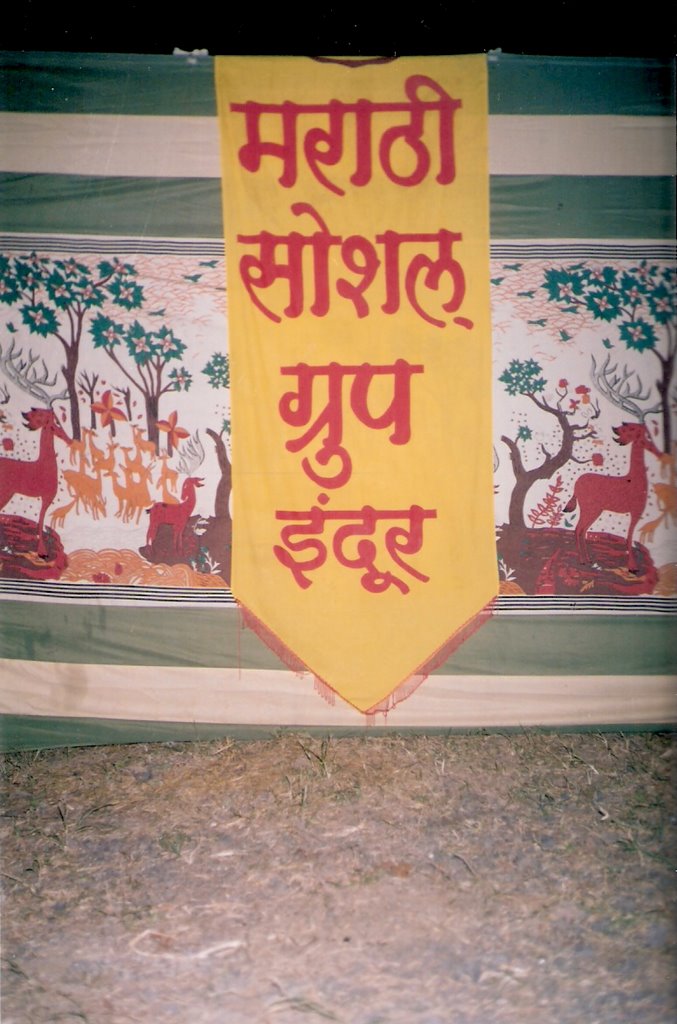

The Lavani dances. These performances were watched by a packed audience.
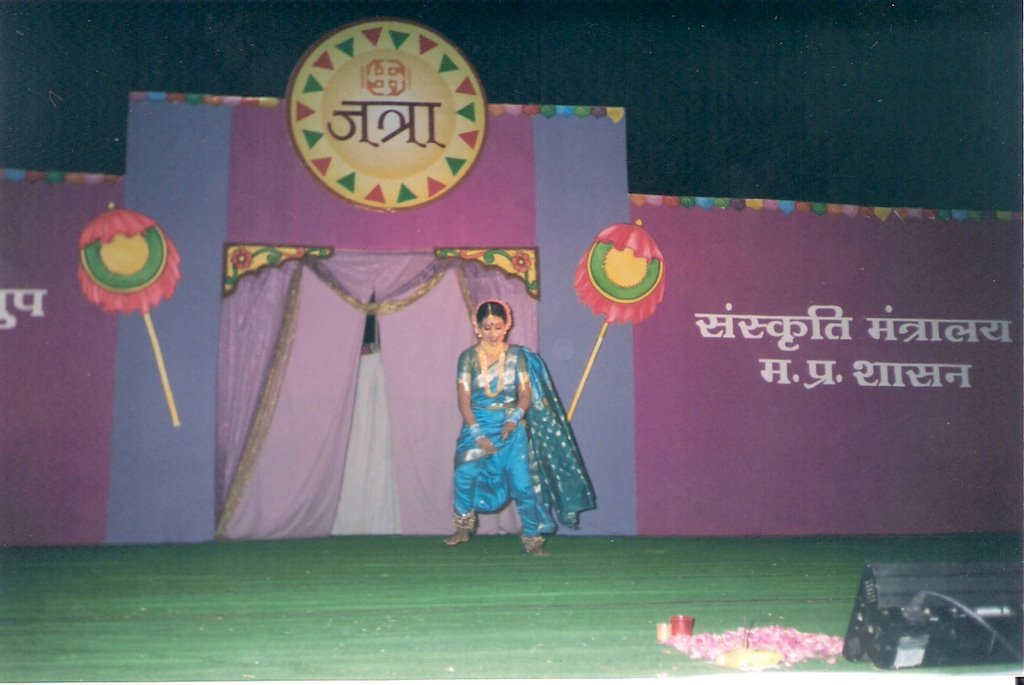

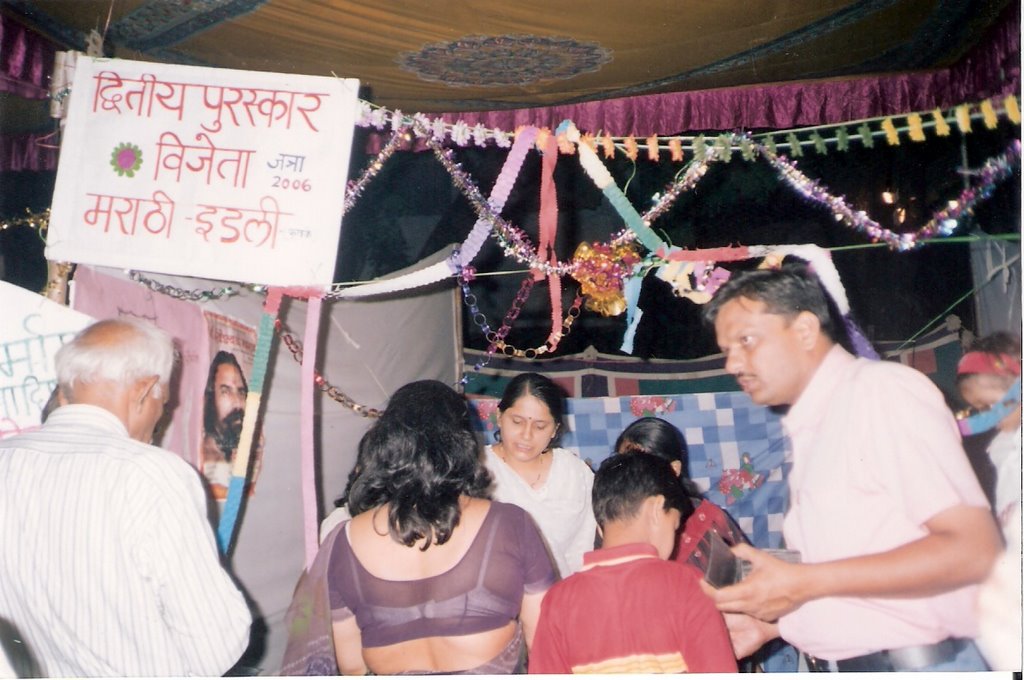
Two of the many stalls in the food zone. One can see the matki vada and marathi idli stalls.


Participating in a pangat and eating a traditional Marathi meal. The menu for the meal is written on the blackboard. I have it written down somewhere. Must find it.
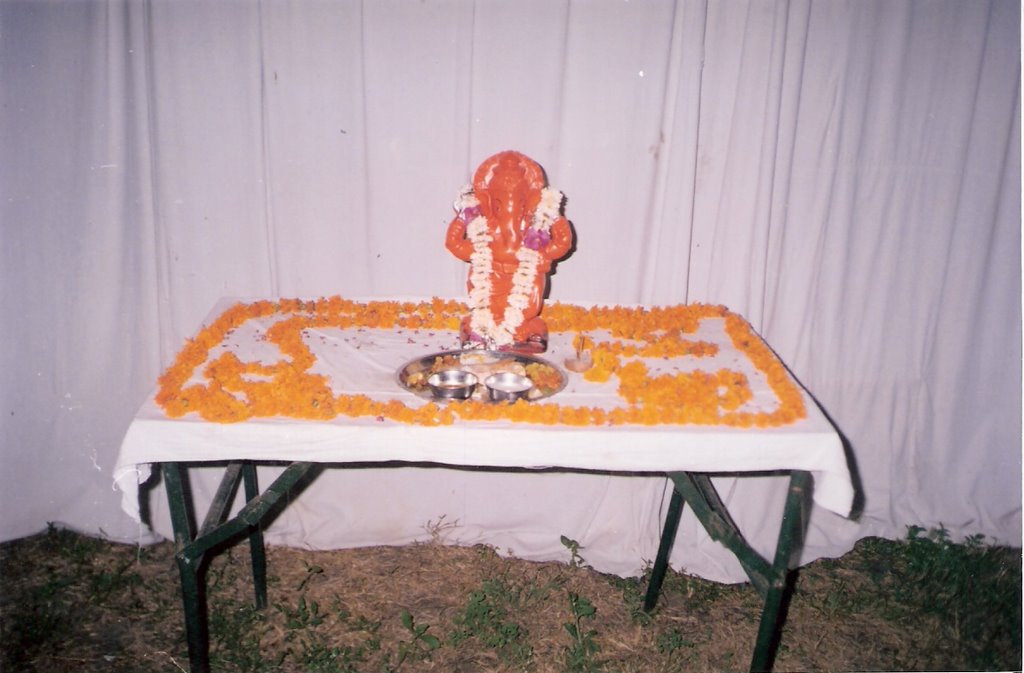

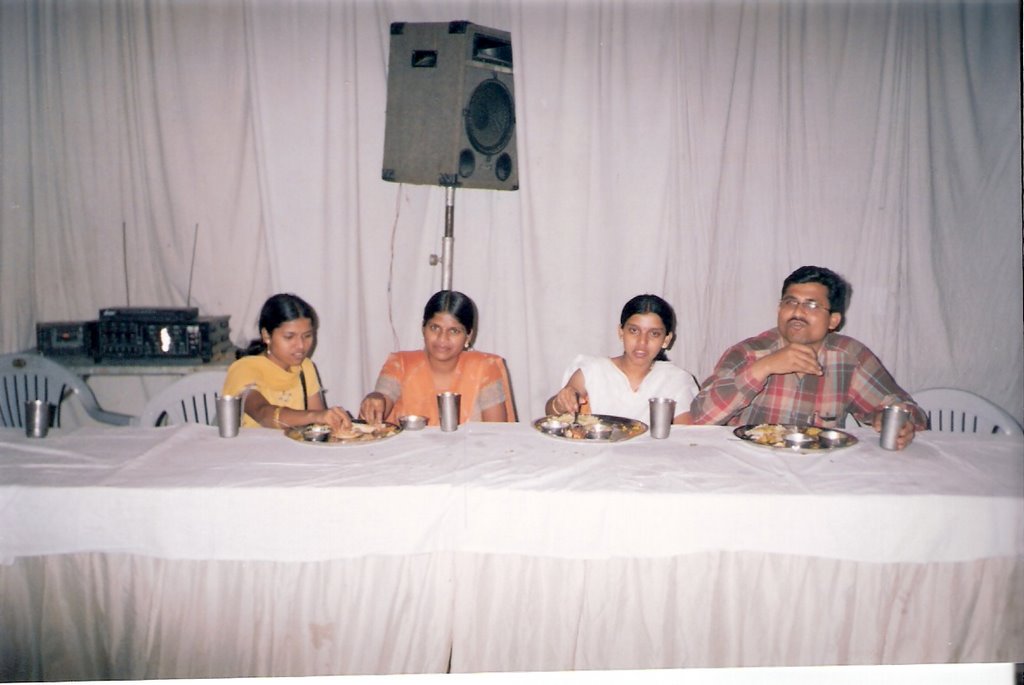
Enjoying their meal. They were very gracious in allowing me to click them. But I had to wait till the giggles had subsided.
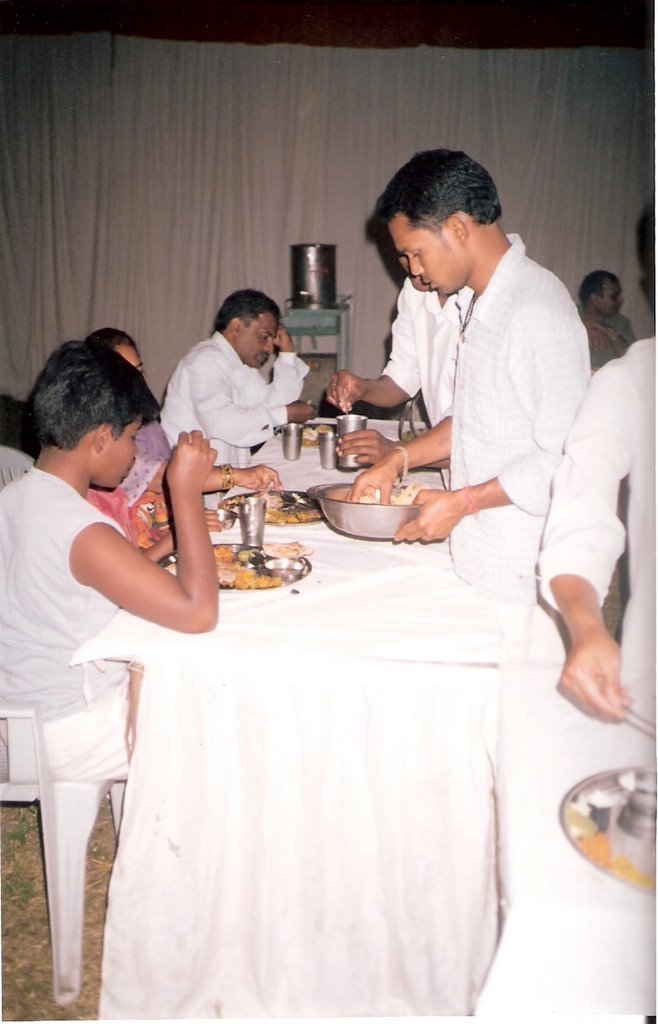
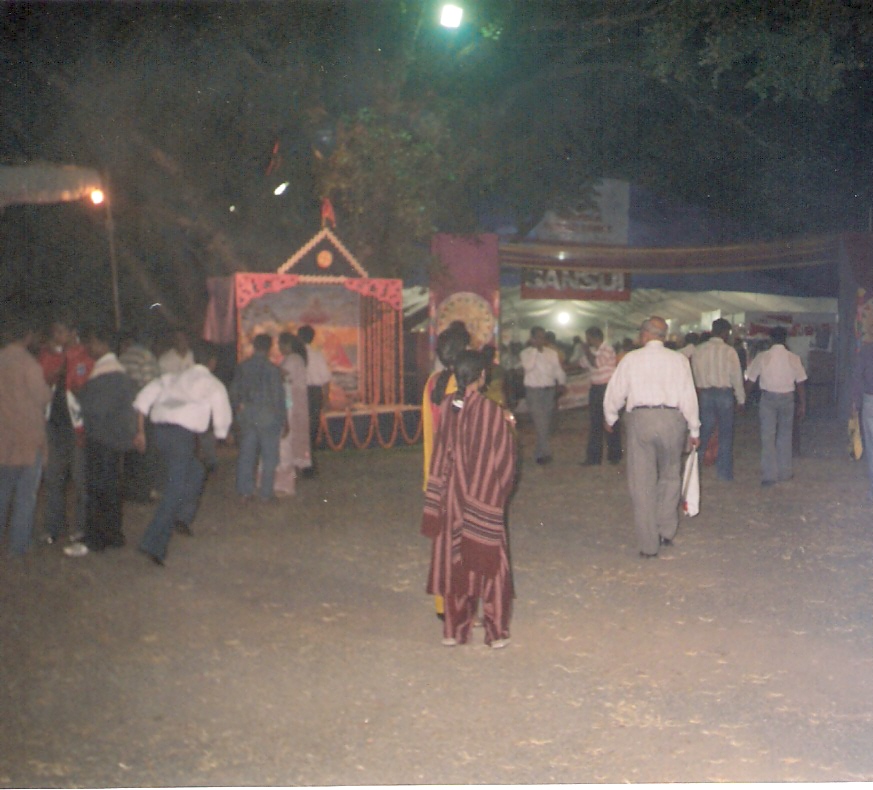
Time to say goodbye. People walking in as I walk towards the parking lot. I wanted to stay longer but it is at least a 25 km drive till my house. Till the next year and the next Jatra.
Monday, September 25, 2006
Remembering Padmini the graceful actor and dancer

My mother told me yesterday morning that the actor and dancer Padmini is no more. I felt that one chapter of my childhood had ended. As a young child growing up in various cantonments the weekly Hindi movie was a great educator and to some extent it neutralised the negative effects of being deprived of Indian inputs. My mother would often talk of Padmini and her sisters. The 'Travancore sisters' as she called them. I guess for someone from outside Kerala and especially for someone from outside South India Padmini would have been just one of those heroines who made the hero's world a little more colourful. In a state like Kerala she must have shocked many by entering the celluloid world. Inspite of their matrilineal traditions and the immense freedom their women enjoyed the land owning Nairs must have been shocked. Not unlike the case of Mallika Sherawat and the conservative society of Haryana. In Mallika's case the desire to shock was a calculated one in Padmini's case the fact that she was acting in films was enough to shock the orthodox.
My mother is my source of information as far as commercial Malayalam cinema is concerned. When she told me some years ago that Shobana ('Dance like a Man', 'Anantaram') is Padmini's niece I became extremely attentive. Another cousin Sukumari is also a one-woman institution in Malayalam cinema. Padmini's ouevre in Hindi cinema was limited but will be remembered. "Payal" [1957], Babubhai Mistry's "Mahabharat" [1965], Raj Kapoor's "Jis Desh Mein Ganga Behti Hai" [1961], and "Mera Naam Joker" [1971].
Her film debut in Udai Shankar's Kalpana, the manner in which she left Travancore and established herself in the Madras film industry, acted in films made in all the South Indian languages and made her mark in Bollywood long before anyone had heard of Kamalahasan or Sridevi is something which has never been recognized. Maybe if she had been a man.
Some excellent links to Padmini are available here.
Tuesday, September 19, 2006
Futility
The little candle eagerly waited
For the match to
Light the flame
And make its life real.
And it waitedAnd waited……
As
All the matches
Were staring at the lamp
And the wonders of electricity
Hoping they could be a
Part of thisNovelty.
Wondrous and beautiful
Full of light….
And the candle and the matches
Waitedand waited
till eternity....
For the match to
Light the flame
And make its life real.
And it waitedAnd waited……
As
All the matches
Were staring at the lamp
And the wonders of electricity
Hoping they could be a
Part of thisNovelty.
Wondrous and beautiful
Full of light….
And the candle and the matches
Waitedand waited
till eternity....
Friday, September 15, 2006
Sarai Reader 06: The theme is "Turbulence"
Amardeep Singh, Assistant Professor of English at Lehigh University has created one of the best literary blogs. I check it out at least once a day. Thanks to this entry in his blog I came to know about issue #6 of Sarai Reader. The articles are available in pdf format.
I have just seen A Candle in my Window by Peter Griffin, whose articles I often read in The Times of India. Peter writes about collaborative blogs and how he and his online friends started an online initiative named Tsunamihelp which evolved into the South-East Asia Earthquake and Tsunami Blog (SEA-EAT blog). A fascinating read. It shows how some of us have harnessed the awesome power of the internet to make a positive difference to the lives of the less fortunate.
Amardeep recommends A City Feeding on itself: Testimonies and Histories of 'Direct Action' Day by Debjani Sengupta. A horrifying account of the riots that took place in Calcutta in 1946.
In Poetry In a Time of Terror the Shillong based Manipuri poet Robin S Ngangom writes of the pain and trauma that the people of his state are going through.
And there are the previous issues too
Reader 1 has 'The Public Domain' as its theme.
Reader 2 has 'The Cities of Everyday Life' as its theme.
Reader 3 has 'Shaping Technologies' as its theme.
Reader 4 has 'Crisis/Media' as its theme.
Reader 5 has 'Bare Acts' as its theme.
Plenty of good stuff here folks. Click away. Thanks Amardeep.
p.s. This happens to be my first post in Neti Neti. Here's looking forward to a long and fruitful association.
I have just seen A Candle in my Window by Peter Griffin, whose articles I often read in The Times of India. Peter writes about collaborative blogs and how he and his online friends started an online initiative named Tsunamihelp which evolved into the South-East Asia Earthquake and Tsunami Blog (SEA-EAT blog). A fascinating read. It shows how some of us have harnessed the awesome power of the internet to make a positive difference to the lives of the less fortunate.
Amardeep recommends A City Feeding on itself: Testimonies and Histories of 'Direct Action' Day by Debjani Sengupta. A horrifying account of the riots that took place in Calcutta in 1946.
In Poetry In a Time of Terror the Shillong based Manipuri poet Robin S Ngangom writes of the pain and trauma that the people of his state are going through.
And there are the previous issues too
Reader 1 has 'The Public Domain' as its theme.
Reader 2 has 'The Cities of Everyday Life' as its theme.
Reader 3 has 'Shaping Technologies' as its theme.
Reader 4 has 'Crisis/Media' as its theme.
Reader 5 has 'Bare Acts' as its theme.
Plenty of good stuff here folks. Click away. Thanks Amardeep.
p.s. This happens to be my first post in Neti Neti. Here's looking forward to a long and fruitful association.
Saturday, September 09, 2006
Onam
Onam is about homecoming. A spirit that takes our being from all corners of the world and swoop in around a magical table where everyone gathers to munch on foregone tastes and memories - of childhood, parents, siblings, flowers and sunlight in the neighborhood.
Let Mahabali return to see us who are after all the same old ourselves - simple and warm people.
Ellavarkkum ente Onaasamsakal.Let Mahabali return to see us who are after all the same old ourselves - simple and warm people.
September: A sudden light shower in the morning, left the yard exhilerated and let it regain composure. The laughter and mirth from the living room grew with sunshine. Today is Onam. There is a weightlessness in reunion and barricading time to slip any further. Spring is now and hope is in the moment. (from an older Article)
* A little late to post this. Better late than never :)
Thursday, August 31, 2006
Ayyappa Panicker passed away
Dr. Ayyappa Panicker(1930-2006) was one of those rare breed of people you would call vocational intellectuals, the ones that you are aware of their appearances in magazines, award committees and the stellar academic achievements but never identified with their work or persona like say some one like O.V.Viajayan or a Borker or Khandekar.
Though regarded a prominent poet attributed with architecting modern Malayalam poetry, he is a ubiquitous man of letters who was active in a lot of movements from behind. He completed B.A Honors from University college, Trivandrum, received Ph.D from Indiana University, for his dissertation on Robert Lowell's poetry. In 1980, he was appointed Professor in the Institute of English and Head of the Department and continued to hold the post till his retirement. The University Grants Commission made him National Lecturer in 1984-85 and he gave lectures in the universities of Gorakhpur, Kolhapur, Karnataka and Bangalore. He was a visiting Professor at Jadavpur University, Calcutta.
"In 1981-82 he did Postdoctoral Research in Yale University (five months) and Harvard University (four months). During this time he visited around 25 Universities in the U.S and became acquainted with internationally renowned poets like James Dickey, John Hollander, Czeslaw Milosz and Allen Ginsberg as well as scholars like Cleanth Brooks, Harold Bloom, Charles Feidelson,Jr., Frederic Jameson and others. "
I quoted this from his website and apparently he was an insider and was regarded as the point man for Indian culture and specifically malayalam literature and art with international reputation. Inevitably he traveled all over the world and attended countless seminars and represnted Indian Literature and Culture. He was also a major endorser of writers and specialised in writing "forwards" for many established writers and sometimes beginners too. No wonder he used to remind us a lot of Harold Bloom.
His contributions in criticism are regarded higly in the fields of comparative literature, especially for poetry in malayalam with English and other Indian languages such as Tamil, Marathi, Kannada, Hindi, Telugu and Bengali. He was also a lifelong celebrity as an English and Linguistics teacher. He effortlessly went along with the essentially leftist intelligentsia in Delhi and Kerala. In short he lived a worthy life that deserved a lot of official obituaries and a little bit of personal ones too from an obscure outsider like me :) May his soul rest in peace and glory.
His website
Some of his poems
Though regarded a prominent poet attributed with architecting modern Malayalam poetry, he is a ubiquitous man of letters who was active in a lot of movements from behind. He completed B.A Honors from University college, Trivandrum, received Ph.D from Indiana University, for his dissertation on Robert Lowell's poetry. In 1980, he was appointed Professor in the Institute of English and Head of the Department and continued to hold the post till his retirement. The University Grants Commission made him National Lecturer in 1984-85 and he gave lectures in the universities of Gorakhpur, Kolhapur, Karnataka and Bangalore. He was a visiting Professor at Jadavpur University, Calcutta.
"In 1981-82 he did Postdoctoral Research in Yale University (five months) and Harvard University (four months). During this time he visited around 25 Universities in the U.S and became acquainted with internationally renowned poets like James Dickey, John Hollander, Czeslaw Milosz and Allen Ginsberg as well as scholars like Cleanth Brooks, Harold Bloom, Charles Feidelson,Jr., Frederic Jameson and others. "
I quoted this from his website and apparently he was an insider and was regarded as the point man for Indian culture and specifically malayalam literature and art with international reputation. Inevitably he traveled all over the world and attended countless seminars and represnted Indian Literature and Culture. He was also a major endorser of writers and specialised in writing "forwards" for many established writers and sometimes beginners too. No wonder he used to remind us a lot of Harold Bloom.
His contributions in criticism are regarded higly in the fields of comparative literature, especially for poetry in malayalam with English and other Indian languages such as Tamil, Marathi, Kannada, Hindi, Telugu and Bengali. He was also a lifelong celebrity as an English and Linguistics teacher. He effortlessly went along with the essentially leftist intelligentsia in Delhi and Kerala. In short he lived a worthy life that deserved a lot of official obituaries and a little bit of personal ones too from an obscure outsider like me :) May his soul rest in peace and glory.
His website
Some of his poems
Wednesday, August 09, 2006
Custodial deaths and Third world citizens
Sushil Kumar, a telephone operator was arrested by Police in Delhi and two days later he was declared dead. The post-mortem report said that the shock of the beating had triggered a heart attack leading to his death. Police said he had died of “natural causes''. The same month Sukhvinder, who had been accused of sheltering alleged ISI agents, died in police custody.
(Hindu)
Mr. Udayakumar, a 28-year-old man, arrested was arrested from a park in Kerala along with his companion on grounds of suspicious circumstances, died due to severe internal injuries when he was severely beaten by policemen.
(Mathrubhumi)
Nagender, was a driver. He was an accused in a fatal motor accident case. A non-bail able warrant was issued when he did not turn up in court. When he was produced before the criminal court, he escaped from the police custody. He was immediately apprehended and remanded to judicial custody, where he died under suspicious circumstance.
(TOI)
Kamal Sharma was a guard of a cement godown in Jangal Basti at Fansideoa, Darjeeling District, West Bengal. On 6 February 2004, the owner of the cement godown, Mr. Dilip Das, lodged a complaint to Fansideoa Police Station that Rs. 92,000 was stolen from his residence. The police arrested Kamal Sharma as a suspect without any reliable evidence on 6 February 2004 and took him to the police station. No stolen money was found in Kamal Sharma's possession. He was later found dead in custody.
(TOI)
We tend to display a lot of apathy for overzealous human rights activists. But take a look at the news mentioned above and there are countless such deathly rituals in progress in police stations around the country. Dates and names don’t matter. Google for “custodial death” and you will find the distinguished position of India in this genre.
The spectacle of dehumanization at work in police stations around the country is no longer news nor does it elicit shock or anger from us. The layman in you is probably relieved that it was somebody else. You could be walking in a park or waiting for the commuter train or an unlikely suspect in a robbery case. As long as you are on your own without political clout or money, you run the risk of being snapped up from your life and the world could suddenly turn upside down for you. Or you could even be a student who mocked the home minister of a state in political overtones ended up in torture cells and vanished without a trace. Remember the notorious Rajan case during “Emergency” in Kerala?
Governments have changed, political faces have changed and the media are on an overdrive to cover anything sensational. Tragically the slaughter-culture in police thana has never been curtailed and is on an alarming rise. The victims of custodial deaths are powerless citizens of the country. Mere impression of your status as the “insignificant voter”, in the mind of a cop throws you in mortal fear. There must any number of pathologically violent cops in India who need to be identified and weeded out.
The euphemistic “rates” for police and abuse of political influence have created a widening gap between “law abiding” citizens and the poor underprivileged. Torture is the natural means of investigation when it comes to the latter category. The delays in courts, negligence of higher ranking officials to inspect illegal and prolonged custody of suspects, general lack of awareness of law among the common people are exploited to the core.
The stigma of poverty follows everywhere. The simple exercise of power by a policeman over common citizens can lead up to third degree torture and death with no access to redress grievances. Sometimes they are just expedient pawns of a larger conspiracy to hide the real but influential culprits. A little bribe is all it takes to deprive a poor man of his life.
There are several reasons that I can think of:
The biggest motivation behind all these killings is a belief that the custodial deaths could never punish the perpetrator. Until this notion changes, there will be custodial deaths. The irony is that if you take away the uniform, the perpetrators would look exactly the same as the victim – faceless, apologetic and limp.
(Hindu)
Mr. Udayakumar, a 28-year-old man, arrested was arrested from a park in Kerala along with his companion on grounds of suspicious circumstances, died due to severe internal injuries when he was severely beaten by policemen.
(Mathrubhumi)
Nagender, was a driver. He was an accused in a fatal motor accident case. A non-bail able warrant was issued when he did not turn up in court. When he was produced before the criminal court, he escaped from the police custody. He was immediately apprehended and remanded to judicial custody, where he died under suspicious circumstance.
(TOI)
Kamal Sharma was a guard of a cement godown in Jangal Basti at Fansideoa, Darjeeling District, West Bengal. On 6 February 2004, the owner of the cement godown, Mr. Dilip Das, lodged a complaint to Fansideoa Police Station that Rs. 92,000 was stolen from his residence. The police arrested Kamal Sharma as a suspect without any reliable evidence on 6 February 2004 and took him to the police station. No stolen money was found in Kamal Sharma's possession. He was later found dead in custody.
(TOI)
We tend to display a lot of apathy for overzealous human rights activists. But take a look at the news mentioned above and there are countless such deathly rituals in progress in police stations around the country. Dates and names don’t matter. Google for “custodial death” and you will find the distinguished position of India in this genre.
The spectacle of dehumanization at work in police stations around the country is no longer news nor does it elicit shock or anger from us. The layman in you is probably relieved that it was somebody else. You could be walking in a park or waiting for the commuter train or an unlikely suspect in a robbery case. As long as you are on your own without political clout or money, you run the risk of being snapped up from your life and the world could suddenly turn upside down for you. Or you could even be a student who mocked the home minister of a state in political overtones ended up in torture cells and vanished without a trace. Remember the notorious Rajan case during “Emergency” in Kerala?
Governments have changed, political faces have changed and the media are on an overdrive to cover anything sensational. Tragically the slaughter-culture in police thana has never been curtailed and is on an alarming rise. The victims of custodial deaths are powerless citizens of the country. Mere impression of your status as the “insignificant voter”, in the mind of a cop throws you in mortal fear. There must any number of pathologically violent cops in India who need to be identified and weeded out.
The euphemistic “rates” for police and abuse of political influence have created a widening gap between “law abiding” citizens and the poor underprivileged. Torture is the natural means of investigation when it comes to the latter category. The delays in courts, negligence of higher ranking officials to inspect illegal and prolonged custody of suspects, general lack of awareness of law among the common people are exploited to the core.
The stigma of poverty follows everywhere. The simple exercise of power by a policeman over common citizens can lead up to third degree torture and death with no access to redress grievances. Sometimes they are just expedient pawns of a larger conspiracy to hide the real but influential culprits. A little bribe is all it takes to deprive a poor man of his life.
There are several reasons that I can think of:
- Lack of relevant training and willingness to enforce code of conduct from authorities.
- Economic status of the country and individual. The statistics of custodial deaths are staggering for third world countries like India, Indonesia, Pakistan and Bangladesh.
- A subculture of the community where it is OK to use violence as a means for perceived justice.
- Ignorance of legal procedures among common people and to some extent among lower order policemen.
- Intervention of political interests and politicization of police force.
- Ill-planned work schedule and lack of resources for lower order police force where they are forced to be on job for way more than 8 hours everyday.
- Terrorism laws being misused to act on poor minority (read Muslim) suspects with impunity.
- Lack of communication and relationship between police force and neighborhood watch (if any) groups.
- Traditional police force unable to cope with changing lifestyle and rapid development of suburban and urban areas.
The biggest motivation behind all these killings is a belief that the custodial deaths could never punish the perpetrator. Until this notion changes, there will be custodial deaths. The irony is that if you take away the uniform, the perpetrators would look exactly the same as the victim – faceless, apologetic and limp.
Saturday, July 29, 2006
Outrage?

Two pictures on the cnn website caught my eye. One had a news article on it. The other was an ad. See for yourself.
Familiar? Now this picture or its derivative has been on cnn’s website for a while. No outrage was visible. If anyone wrote in to protest that kids might be looking at cnn’s website and this was not an appropriate picture on the first page, then I definitely missed it. For my part, I have” netnanny” safely installed on my kids’ computer which blocks these pictures so I don’t worry that much.
However, when I saw this news article
http://www.cnn.com/2006/US/07/27/nursing.cover.ap/index.html

and the accompanying picture having caused outrage, I found my mind in the biggest muddle ever. When the spinning stopped, having given rise to sheer amusement at the colossal mix-up, the implication of this hit me between the eyes. Allow me to share some of this here.
The breastfeeding mother is a matter of shame(?) . While I don’t really consider myself a lactivist, and definitely do not remember ever breastfeeding in public, (I put it down to my conservative upbringing in a traditional culture), something made me laugh loudly at the stupidity of all of this. However on reading this article, especially the following lines, I realized something here smacked of a hypocrisy, more on the part of women, than the men who are blamed for being “visual.”
This line specially caught my eye.
"I'm totally supportive of it -- I just don't like the flashing," she said. "I don't want my son or husband to accidentally see a breast they didn't want to see."
While am all for this point of view, I just don’t see the same reaction at picture of half naked women on big billboards selling underwear. Something is incongruent about the acceptance of the woman’s body as sexual object, but not as a mother. Is it just me who views this inconsistency as something to ponder? What is also very interesting is that it’s the women who “doth protest too much” about the lactating breast, while remaining silent about the other ads, far more ubiquitous than the “Babytalk” magazine. Not to be dismissive, but I doubt the readership of Babytalk exceeds the viewer ship of the “Victoria Secret” ads.
As a follower of the “cult of motherhood,” is it time to take strong objection to this? Mostly tongue in cheek, of course? How is it women don’t figure out they put a foot in their mouth the moment they protest things like this, while the silent men are merely amused at the lack of feminine self identities? All while “enjoying the show” as well as the comedy of collective stupidity.
Wednesday, July 19, 2006
Contemporary Reflections...
I’m not easily given to write about politics. Let me , however, illustrate two examples from contemporary world and share my thoughts on them.
[1]It’s a mystery to me to see that a race whose average IQ is about 120 permit itself the same mistake again and again. How amazingly incongruent it is to find the people who are known to be exceedingly thoughtful in most spheres suddenly fail to see how they are becoming the victims of their own defensiveness. To put it plainly, this nation did not exist a few decades back and since its inception has been engaging or made to engage in repeated political conflicts one after another. And given the history of persecution, if at all anyone , it is them you expect to realise the futility of the course of their action- this is the third time Israel is officially entering Lebanon and the conflict is nowhere near a feasible solution, in fact one easily can see the trammelled repercussions in the near future. With the vulnerable geopolitics of the region, it is only prudent for Israel to understand the fact it cannot ensure the security of her subjects by bringing herself under the umbrella and to continuously engage in reactionary acts of questionable morality.
Israel has to, in the larger interest of the Jewish race, regard herself as a nation willing to progressively exclude herself from the troubles of her neighbourhood and thereby work towards a lasting solution which can be achieved only by concerted peaceful talks. Simply because, as we all know, parting the sea does not happen quite often.
[2]The second , perhaps the more entertaining example is the response of Indian Blogosphere to the apparent ban on a dozen websites allegedly perceived as a threat to national security. I say apparent because I lack reliable information regarding the exact nature and the premise of the ban. Except for one news-piece, all my sources are friends and other bloggers.
To me, the greatest surprise is bloggers arguing against the ban calling it unlawful and against the principles of democracy. I found a few others writing sarcastic notes stating how their art, movie or culinary posts may lead to compromise of security. And that tickles me no end making me wonder if such populations who have never been outside democracy actually deserve to be in a democracy. It has been my observation for over a period of time that , just because they have a a English medium education and a modem , Indian blogs rant their self righteous opinion right left and centre with a conviction as fixed as a lamp-post to the ground. I reckon very few people in India actually understand the concept of democracy, for the rest it is phrases like free speech, free rights etc..and more dishearteningly, all this in a nation which practised the best ever seen form of democracy in the human history to gain her independence. Esp. the 1920s-An active civil disobedience aimed at highlighting the injustice and not to embarrass the opponent.
Its all sad.
Surely, democracy entitles one to free rights and speech et al, but that does not necessarily mean you can say or act whatever that crosses your mind; that only leads to anarchy. There is nothing illegal about a democratically elected government choosing to ban a number of portals in the interest of her subjects. Neither anyone has been singled out unjustly for writing about art/movies nor anyone’s freedom of speech has been curtailed. No one has been discriminated against, it is a blanket ban and some people are affected , for no fault of theirs. It is rather unfortunate if you are to lose out in the process, but we all have to play our part in the national issues.
But yes, you are completely justified in challenging the reasons behind the ban or questioning the need for ban at all. And writing a blog claiming it as undemocratic is not the way to go about it. That amounts to nothing but airing and sharing your frustration, which in fact could be argued as misdirected practice of democracy.
PS- I personally have no view on the ban as of now, but as a matter of principle, I am for a completely justified ban by the state accountable to her subjects. When I mean justified- I mean one, based on reason and not on prejudices.
[1]It’s a mystery to me to see that a race whose average IQ is about 120 permit itself the same mistake again and again. How amazingly incongruent it is to find the people who are known to be exceedingly thoughtful in most spheres suddenly fail to see how they are becoming the victims of their own defensiveness. To put it plainly, this nation did not exist a few decades back and since its inception has been engaging or made to engage in repeated political conflicts one after another. And given the history of persecution, if at all anyone , it is them you expect to realise the futility of the course of their action- this is the third time Israel is officially entering Lebanon and the conflict is nowhere near a feasible solution, in fact one easily can see the trammelled repercussions in the near future. With the vulnerable geopolitics of the region, it is only prudent for Israel to understand the fact it cannot ensure the security of her subjects by bringing herself under the umbrella and to continuously engage in reactionary acts of questionable morality.
Israel has to, in the larger interest of the Jewish race, regard herself as a nation willing to progressively exclude herself from the troubles of her neighbourhood and thereby work towards a lasting solution which can be achieved only by concerted peaceful talks. Simply because, as we all know, parting the sea does not happen quite often.
[2]The second , perhaps the more entertaining example is the response of Indian Blogosphere to the apparent ban on a dozen websites allegedly perceived as a threat to national security. I say apparent because I lack reliable information regarding the exact nature and the premise of the ban. Except for one news-piece, all my sources are friends and other bloggers.
To me, the greatest surprise is bloggers arguing against the ban calling it unlawful and against the principles of democracy. I found a few others writing sarcastic notes stating how their art, movie or culinary posts may lead to compromise of security. And that tickles me no end making me wonder if such populations who have never been outside democracy actually deserve to be in a democracy. It has been my observation for over a period of time that , just because they have a a English medium education and a modem , Indian blogs rant their self righteous opinion right left and centre with a conviction as fixed as a lamp-post to the ground. I reckon very few people in India actually understand the concept of democracy, for the rest it is phrases like free speech, free rights etc..and more dishearteningly, all this in a nation which practised the best ever seen form of democracy in the human history to gain her independence. Esp. the 1920s-An active civil disobedience aimed at highlighting the injustice and not to embarrass the opponent.
Its all sad.
Surely, democracy entitles one to free rights and speech et al, but that does not necessarily mean you can say or act whatever that crosses your mind; that only leads to anarchy. There is nothing illegal about a democratically elected government choosing to ban a number of portals in the interest of her subjects. Neither anyone has been singled out unjustly for writing about art/movies nor anyone’s freedom of speech has been curtailed. No one has been discriminated against, it is a blanket ban and some people are affected , for no fault of theirs. It is rather unfortunate if you are to lose out in the process, but we all have to play our part in the national issues.
But yes, you are completely justified in challenging the reasons behind the ban or questioning the need for ban at all. And writing a blog claiming it as undemocratic is not the way to go about it. That amounts to nothing but airing and sharing your frustration, which in fact could be argued as misdirected practice of democracy.
PS- I personally have no view on the ban as of now, but as a matter of principle, I am for a completely justified ban by the state accountable to her subjects. When I mean justified- I mean one, based on reason and not on prejudices.
Monday, July 17, 2006
Anatomy of riots and mob violence in India
Mob violence has been occurring since human beings started recording history, verbal and written. The secular governments create environs for lumpenisation of urban and semi-urban locations with its mapping and reorientation of voter (read ideological and religious blocks). The anti-democratic or even anti-government forces would always look to use to these lumpen elements to unleash atrocities against innocent and defenseless people.
I remember watching a movie called “Z” by Kosta Gavra which narrated the ringside view of a political assassination orchestrated in the guise of mob violence. It showed the ways in which State uses the lumpen elements of society and unlawful manipulation of its machinery to eliminate political threats for survival. Cuban director Thomas Elia depicted the mob violence as an inevitable threshold of social transition and he showed no mercy for the degenerating feudal family and their extermination by the rampaging mob. Similar point of view was portrayed by Emile Zola in his book Germinal where a bunch of hapless colliers reduced to lumpen existence took to arms to survive. Amrita Pritam painted the deep wounds of partition and a nation’s conscience in her fiction Pinjar (Skeleton). Shashi Tharoor’s Riot is another recent work displaying the chimerical façade of reality and apprehensions of secular Muslim, past grievances of militant Hindu and bureaucrats functioning anarchy.
The effort to confine the flare-ups, spread and retaliatory responses of a riot in ideological (religious, secular) terms is very limiting to comprehend the experiential dimensions of the conflict. The official narratives of several parties narrow it down further to guilt of perpetrators, inciters and a presumably complicit State. While it is fairly easy to determine State and its apparatuses role what is lost in discussion is the victim’s narrative of the events as they unfold and how they become targets identified with the causes (religious or ethnic) of conflict. 1Fadjar Thufail mentions about the need of locating violence in the habitus of religious and ethnic certainty becoming the most serious obstacle to any effort to explore the narrated ephemerality of violence experience in his thesis on South Asian riots.
2Elias Canetti’s Crowd and Power (1966) in the words of Susan Sontag dissolved politics into pathology, society is treated as a mental activity and its barbaric self decoded. Crowd Vs individual, the animalistic drive to out-survive others, grips of fear psychosis and the behavior pattern of crowd being different from the individuals who make up the crowd as units. Canetti took 30 years to complete this brilliant work of rare insights and revelation.
Riots erupted after Cartoon controversies all over Islamic domiciles exemplified the sway of crowd power over seemingly insulated and free societies in Europe.
One of the memorable images from Gujarat riot was Qutubuddin Ansari’s teary eyed plea for life in front of a baying mob. The politics of this heart wrenching image is as enigmatic as the actual event. The narrative of this very image by a religious individual or a secular ideologue or an apolitical entity, would lead to further expressions of conflict in the mass media, intelligentsia and socio-political forums to understand not just the victim-perpetrator relationship, religious and ethnic undertones, flagrant spread of violence across extensive locations and linger over longer periods.
It is important to understand the local dynamics of afflicted community and trace back to the origins of conflict before the aftermath overwhelms our perception and political entities swoop in for the takeover. A self sustainable society must be able to introspect critically and allow humanistic perspectives to unravel the wounds to decide how to heal them.
I will try and follow this up with the politics of Riots.
1. Fadjar Thufail: Ph. D Scholar, Uni. Of Wisconsin. I owe him the concept of this blog.
2. Elias Canetti, German Writer and Thinker
I remember watching a movie called “Z” by Kosta Gavra which narrated the ringside view of a political assassination orchestrated in the guise of mob violence. It showed the ways in which State uses the lumpen elements of society and unlawful manipulation of its machinery to eliminate political threats for survival. Cuban director Thomas Elia depicted the mob violence as an inevitable threshold of social transition and he showed no mercy for the degenerating feudal family and their extermination by the rampaging mob. Similar point of view was portrayed by Emile Zola in his book Germinal where a bunch of hapless colliers reduced to lumpen existence took to arms to survive. Amrita Pritam painted the deep wounds of partition and a nation’s conscience in her fiction Pinjar (Skeleton). Shashi Tharoor’s Riot is another recent work displaying the chimerical façade of reality and apprehensions of secular Muslim, past grievances of militant Hindu and bureaucrats functioning anarchy.
The effort to confine the flare-ups, spread and retaliatory responses of a riot in ideological (religious, secular) terms is very limiting to comprehend the experiential dimensions of the conflict. The official narratives of several parties narrow it down further to guilt of perpetrators, inciters and a presumably complicit State. While it is fairly easy to determine State and its apparatuses role what is lost in discussion is the victim’s narrative of the events as they unfold and how they become targets identified with the causes (religious or ethnic) of conflict. 1Fadjar Thufail mentions about the need of locating violence in the habitus of religious and ethnic certainty becoming the most serious obstacle to any effort to explore the narrated ephemerality of violence experience in his thesis on South Asian riots.
2Elias Canetti’s Crowd and Power (1966) in the words of Susan Sontag dissolved politics into pathology, society is treated as a mental activity and its barbaric self decoded. Crowd Vs individual, the animalistic drive to out-survive others, grips of fear psychosis and the behavior pattern of crowd being different from the individuals who make up the crowd as units. Canetti took 30 years to complete this brilliant work of rare insights and revelation.
Riots erupted after Cartoon controversies all over Islamic domiciles exemplified the sway of crowd power over seemingly insulated and free societies in Europe.
One of the memorable images from Gujarat riot was Qutubuddin Ansari’s teary eyed plea for life in front of a baying mob. The politics of this heart wrenching image is as enigmatic as the actual event. The narrative of this very image by a religious individual or a secular ideologue or an apolitical entity, would lead to further expressions of conflict in the mass media, intelligentsia and socio-political forums to understand not just the victim-perpetrator relationship, religious and ethnic undertones, flagrant spread of violence across extensive locations and linger over longer periods.
It is important to understand the local dynamics of afflicted community and trace back to the origins of conflict before the aftermath overwhelms our perception and political entities swoop in for the takeover. A self sustainable society must be able to introspect critically and allow humanistic perspectives to unravel the wounds to decide how to heal them.
I will try and follow this up with the politics of Riots.
1. Fadjar Thufail: Ph. D Scholar, Uni. Of Wisconsin. I owe him the concept of this blog.
2. Elias Canetti, German Writer and Thinker
Friday, July 07, 2006
Autumn Years and neti neti.
The reality of old age first hit me when my grandmother fell ill. Everyone knew it was only a matter of time the end would arrive. This knowledge showed in people’s lack of hope, slow actions and expression of tiredness in how they took care of her. My father kept doing things, as though she would recover, and something in that effort made me see him as a child, clinging on to the hope his mother would continue living. She was not able to move, literally a bag of bones I didn’t recognize, was not able to eat, and had to be turned every couple of hours, so she would not get bed sores. However, her eyes were clear when she was awake, and even though she did not have much strength to speak, her eyes were expressive, and the countless emotions in them did not find names in my limited vocabulary.
I remembered the time she was strong and articulate, and full of energy. Her laughter, pithy comments, and temper, were legendary. Her sense of power affected everyone who came into contact with her. She had a regal bearing about her and was able to bring this sense of authority into any situation she found herself in. As a child, I always felt she was an important person from the way people deferred to her when she was present. Also the way, they hesitated in expressing dissent when they didn’t agree with her showed something I didnt quite grasp then. Now I view these things in many different ways but as a child, there was an attraction I felt to her. Her view of the world fascinated me, which was very complex and colorful, and quite different from the black and white, good and bad world, that books and school painted for us. She sang songs and told me many stories that I don’t remember clearly. Sometimes a certain taste wafts into my mouth when I hear a tune, or a scene which matches a certain setting she had described.
Seeing her so severely incapacitated, leading upto the moments of her death, opened up doors of perception I did not know I had. For the most part I felt pity. Her regret for the things she had left undone was very visible to me. She seemed impatient to set things right and was sad she did not have the strength to do so. Her desire to express love and care seemed very innocent to me as she had lived sternly, hiding emotions and her own vulnerabilities, always insistent on being the strong person. She held onto our little hands and looked at us with deep love. Her eyes followed my father around, as he tirelessly worked to take care of her. It surprised me as she had always seemed annoyed by him when she was “alive.” His quietness, and gentle being irritated her and I was now able to see the irritation stemmed from her frustration at what she thought was his “weakness.”
It struck me then, and again at countless times, when interacting with old people, that the traps of thoughts finally overtake one’s being, as escape through action. Its almost as though the web of false beliefs that people collect over time has no escape and the more people try and act, an ability diminshed with age, the more entangled they get. Just being quiet would cause many such entanglements to fall away, crafting smiles that reach the eyes.
A well lived life creates a sense of freedom in old age that I have since seen in the eyes of many other older people, who have not left kind words unsaid, or love unshared. Is it possible that the only people, who are rich in this strange twilight of time, are those who have recognized and shared their most valuable possession, their own self? When that is given away through love, what further fear of loss can exist? The fear that all unhappy old people share has fascinated me greatly. It’s almost as though the fear is childlike, of losing their favorite toys, which over the years take shape of things, people, and beliefs. It’s also ironical to me that the more people cling to these crutches of relationships, things, the more they seem fearful of losing it. The ones who prided themselves about their physical well being react more to being ill and desperately seek cure after cure, in the hope something will restore them to a wellbeing they knew. The urgency of chasing mirges grows more desperate as time passes, creating quiet deperations and prisons in their minds.
There are those who live with laughter and love. Their crinkly smile that touches not only their eyes, but every part of their being is one of the most beautiful things that I have seen. That joy touches my core when I am fortunate enough to be witness to its rare occurence They seem free from cares and enjoy the fulfillment of lives well led. This mirror of life that confronts the deepest self, from which there is no escape, is almost like the magic mirror in fairytales. What you see is what has been created, bit by bit, in a million small moments of thoughts and actions. To be able to live quietly, in nature, close to oneself and those one has loved in one’s heart, is probably the most beautiful end imaginable. Through the years, the false views fall away, leaving just the core.
Not this, not that, not this, not that, then seems to be a refrain for living.
I remembered the time she was strong and articulate, and full of energy. Her laughter, pithy comments, and temper, were legendary. Her sense of power affected everyone who came into contact with her. She had a regal bearing about her and was able to bring this sense of authority into any situation she found herself in. As a child, I always felt she was an important person from the way people deferred to her when she was present. Also the way, they hesitated in expressing dissent when they didn’t agree with her showed something I didnt quite grasp then. Now I view these things in many different ways but as a child, there was an attraction I felt to her. Her view of the world fascinated me, which was very complex and colorful, and quite different from the black and white, good and bad world, that books and school painted for us. She sang songs and told me many stories that I don’t remember clearly. Sometimes a certain taste wafts into my mouth when I hear a tune, or a scene which matches a certain setting she had described.
Seeing her so severely incapacitated, leading upto the moments of her death, opened up doors of perception I did not know I had. For the most part I felt pity. Her regret for the things she had left undone was very visible to me. She seemed impatient to set things right and was sad she did not have the strength to do so. Her desire to express love and care seemed very innocent to me as she had lived sternly, hiding emotions and her own vulnerabilities, always insistent on being the strong person. She held onto our little hands and looked at us with deep love. Her eyes followed my father around, as he tirelessly worked to take care of her. It surprised me as she had always seemed annoyed by him when she was “alive.” His quietness, and gentle being irritated her and I was now able to see the irritation stemmed from her frustration at what she thought was his “weakness.”
It struck me then, and again at countless times, when interacting with old people, that the traps of thoughts finally overtake one’s being, as escape through action. Its almost as though the web of false beliefs that people collect over time has no escape and the more people try and act, an ability diminshed with age, the more entangled they get. Just being quiet would cause many such entanglements to fall away, crafting smiles that reach the eyes.
A well lived life creates a sense of freedom in old age that I have since seen in the eyes of many other older people, who have not left kind words unsaid, or love unshared. Is it possible that the only people, who are rich in this strange twilight of time, are those who have recognized and shared their most valuable possession, their own self? When that is given away through love, what further fear of loss can exist? The fear that all unhappy old people share has fascinated me greatly. It’s almost as though the fear is childlike, of losing their favorite toys, which over the years take shape of things, people, and beliefs. It’s also ironical to me that the more people cling to these crutches of relationships, things, the more they seem fearful of losing it. The ones who prided themselves about their physical well being react more to being ill and desperately seek cure after cure, in the hope something will restore them to a wellbeing they knew. The urgency of chasing mirges grows more desperate as time passes, creating quiet deperations and prisons in their minds.
There are those who live with laughter and love. Their crinkly smile that touches not only their eyes, but every part of their being is one of the most beautiful things that I have seen. That joy touches my core when I am fortunate enough to be witness to its rare occurence They seem free from cares and enjoy the fulfillment of lives well led. This mirror of life that confronts the deepest self, from which there is no escape, is almost like the magic mirror in fairytales. What you see is what has been created, bit by bit, in a million small moments of thoughts and actions. To be able to live quietly, in nature, close to oneself and those one has loved in one’s heart, is probably the most beautiful end imaginable. Through the years, the false views fall away, leaving just the core.
Not this, not that, not this, not that, then seems to be a refrain for living.
Friday, June 30, 2006
A few lines on Bollywood...
Caught up with a couple of bollywood movies after a long time during the recent Indian visit.
First one because it was generally branded as a cult, a milestone in Bollywood; including the BBC online waxing...'Accomplished and universally appealing, this is the way Bollywood films should be made....''
1. A bunch of happy go lucky students prodded by a firang rationalise personal grief and outpour unto the nation as revolution. 'Maar daalo use'. Finish --end of the story!
Then what do you know what it takes for any 'educated adult of normal intelligence' to kill his dad? A couple of cigarettes and couple of ‘nautanki hein saala’ lines. 'Maar daalo use bhi'. Finish-- end of the story as well.
When I’ve put a case on similar lines , I found distasteful thoughtless defence that wouldn’t even sell a matchstick like - ‘but its better than so many other movies released in bollywood’.
The point, my dear friend is what a piece of art can hold within itself per se?, because it is obvious that compared to shit even puke seems better.
The songs , the stronghold domain of Bollywood, were definitely well crafted with apt picturization,(esp personal fav tu bin bataaye) considering that somewhere around a decade back bollywood used to compose songs like ‘tu tu tu tutu taara, something dil bechaara’!!
For more observant peeps a subtler query would be - Susan(Sue) , the hindi swearing, all dancing, all passionate about India firang? Why doesn’t she dive off into the pool like other Indians ?
Sorry did I hear cult movie? Long way mate...
I dont regret watching it but I woudnt remember it either. Im happy with a Dvd of all the songs.
2.The other was described as an inspiration from Godfather. I wanted to see it because it was made by a guy who gave our generation one decent movie to look back to. So then, a general quiz show host, Reynolds pen salesman with no serious furthering desire or ambition is brought in to serve as a Hindi Godfather. The chap generally lazes around , drinking teas (from a saucer!!) , hardly speaks and looks like a Doberman gazing first here, then there , then again somewhere at the floor, finally at the corner all through for the absolutely unfathomable and irrelevant background score which goes like govindaa govindaa govindaaa.... repeatedly until he gets back to his saucer again. Now that’s what would be acting!! We are sorry if you missed the method!
Readers may feel that Im quite caustic and not considered in my view and also that I have ignored a few other positives, both of which I do not deny. I feel very strongly because for a nation that cant afford a decent meal for her own people, India produces about 1200 such movies a year, each worth a few million, unaccounted to any value or any identity. Not even to sense. Just like that. Manipulated and packaged entertainment. The above mentioned movies I’m told are the better ones. I cant even begin to imagine the state of the rest.
Such a colossal shame.
Then,one look at states like Denmark, Belgium , Iran, et al turns that into disgust and anger in no time.
First one because it was generally branded as a cult, a milestone in Bollywood; including the BBC online waxing...'Accomplished and universally appealing, this is the way Bollywood films should be made....''
1. A bunch of happy go lucky students prodded by a firang rationalise personal grief and outpour unto the nation as revolution. 'Maar daalo use'. Finish --end of the story!
Then what do you know what it takes for any 'educated adult of normal intelligence' to kill his dad? A couple of cigarettes and couple of ‘nautanki hein saala’ lines. 'Maar daalo use bhi'. Finish-- end of the story as well.
When I’ve put a case on similar lines , I found distasteful thoughtless defence that wouldn’t even sell a matchstick like - ‘but its better than so many other movies released in bollywood’.
The point, my dear friend is what a piece of art can hold within itself per se?, because it is obvious that compared to shit even puke seems better.
The songs , the stronghold domain of Bollywood, were definitely well crafted with apt picturization,(esp personal fav tu bin bataaye) considering that somewhere around a decade back bollywood used to compose songs like ‘tu tu tu tutu taara, something dil bechaara’!!
For more observant peeps a subtler query would be - Susan(Sue) , the hindi swearing, all dancing, all passionate about India firang? Why doesn’t she dive off into the pool like other Indians ?
Sorry did I hear cult movie? Long way mate...
I dont regret watching it but I woudnt remember it either. Im happy with a Dvd of all the songs.
2.The other was described as an inspiration from Godfather. I wanted to see it because it was made by a guy who gave our generation one decent movie to look back to. So then, a general quiz show host, Reynolds pen salesman with no serious furthering desire or ambition is brought in to serve as a Hindi Godfather. The chap generally lazes around , drinking teas (from a saucer!!) , hardly speaks and looks like a Doberman gazing first here, then there , then again somewhere at the floor, finally at the corner all through for the absolutely unfathomable and irrelevant background score which goes like govindaa govindaa govindaaa.... repeatedly until he gets back to his saucer again. Now that’s what would be acting!! We are sorry if you missed the method!
Readers may feel that Im quite caustic and not considered in my view and also that I have ignored a few other positives, both of which I do not deny. I feel very strongly because for a nation that cant afford a decent meal for her own people, India produces about 1200 such movies a year, each worth a few million, unaccounted to any value or any identity. Not even to sense. Just like that. Manipulated and packaged entertainment. The above mentioned movies I’m told are the better ones. I cant even begin to imagine the state of the rest.
Such a colossal shame.
Then,one look at states like Denmark, Belgium , Iran, et al turns that into disgust and anger in no time.
Subscribe to:
Posts (Atom)
